Showing posts with label Teaching. Show all posts

Friday, November 9, 2012

Teaching "x = 'why'"

Previously, I shared in this blog the experiences of a Washington Post reporter who went back and spent a year taking high school math. A lot could be learned by returning to the classroom. Having been in a profession offers new perspectives, certainly a new vantage point, to see high school education. These are anecdotes yet useful insights can be drawn from all of these. Another useful immersion has been recently described by Harvey Mudd College professor of mathematics Darryl Yong. Professor Yong spent his recent sabbatical teaching high school math classes in a large urban school district. Yong wrote a wonderful piece describing his experiences as well as his thoughts on this unusual excursion in the Notices magazine of the American Mathematical Society:
http://www.ams.org/notices/201210/rtx121001408p.pdf
The piece illustrates an example of how higher education may be able to help society understand the needs of basic education. For such an immersion to be genuine, it is important that classroom conditions are not altered simply to please a guest lecturer in high school. Otherwise, it defeats the purpose of experiencing first hand what it really means to teach elementary or high school. Professor Yong clearly did not receive special treatment as the following excerpt demonstrates:

...As a final illustration of the kinds of frustration that teachers face, here is an excerpt of a letter I received from my school district a few weeks after the end of the school year.
Dear YONG, DARRYL:
Our records show that you have received an overpayment as a result of a change that was processed in June 2010. The total adjusted gross amount  of your overpayment (reduced by any
retirement contribution) is $12,197.66. This letter is intended to advise you of  your options in repaying the identified overpayment.
The letter was not signed by anyone, there was no contact person listed, and there was no phone number to call! The letter seemed to make it impossible to contest the overpayment; it only listed options for repayment and threatened referral to a collections agency if the amount was not repaid....
Seeing the above proves to anyone without any doubt that this immersion was real and what Yong has to say about teaching in high school reflects a genuine scenario. What he describes in his piece is therefore worth our time. His reflections provide a deeper vision of basic education seen through the eyes of a professor in mathematics. And here are the main points, which he appropriately calls lessons, that he raises in his essay:

  • Basic education schools are complex. Even this is still an understatement. When schools fail, explanations (or excuses) offered are usually too simplistic, thus, depriving society the complete view to address properly the problems. In the Philippines, the old ten-year curriculum described as congested has been pinpointed as the main culprit in the poor state of basic education. The explanation, however, is more of a justification to go to K to 12, than a sincere and in-depth examination of the situation. These are excuses and are no different from knee-jerk comments made by high school teachers regarding how poor they perceive elementary school education is. As Professor Yong writes, "Simplistic diagnoses are dangerous because they encourage quick fixes. Instead of long-term plans for systemic change, school reform becomes a series of short-lived fads that cause teachers to become jaded by unfulfilled promises of improvement." This explains in part why reform after reform, problems in basic education remain. 
  • It helps to have a teacher who has mastery of the subject content but this is no guarantee for high student learning. Yong cites a study made by  Hattie (John Hattie, Visible Learning: A Synthesis of over 800 Meta-Analyses Relating to Achievement, Routledge, 2009.) that shows that a how a student views himself or herself with regard to the subject counts significantly towards the learning outcome in that domain. If a student begins with a perception of weakness in mathematics, this has serious implications on the student's performance in math. Thus, if student's performance correlates with what we perceive as high quality teaching then effective teaching must be able to address and correct a student's preconception of the subject. Perhaps, this is a major difference between an effective and an ineffective teacher. The following excerpt from Yong illustrates this vividly:
I initially spent a great deal of time thinking of fun or creative lessons that would get students excited. These lessons rarely worked because they were often too complicated or inappropriate for my students’ mathematical development. Instead, I began to design my lessons and accompanying student work so that (1) all of my students could successfully complete the first problem or task independently, and in which (2) the sequence of problems/tasks matched my students’ tolerance for challenge and self-concept. 
This strategy not only increased student learning but also eliminated most of the discipline issues in my class and relieved the pressure of having to develop whiz-bang “fun” lessons every day. 
                    • There is a great need to understand correctly what the teaching profession entails. No different from the practice of medicine, the teaching profession is an ongoing learning. Only with the realization of the emotional, physical and intellectual demands of teaching, would society understand and begin to truly respect teachers. If society treats its physicians in a similar manner as teachers are currently treated in the Philippines, for example, one could only wonder what will happen to the quality of health care and medical services.
                    • The last lesson Yong shares is that the "Written curriculum does not matter." What matters is what actually occurs inside the classroom. In this respect, the teacher serves a central role.
                    Yong's experiences are rich with insights and I invite everyone interested in improving the state of basic education to read his article. 


                    Thursday, November 8, 2012

                    Teacher Quality: Getting the Right People to Lead the Classroom

                    Teachers shoulder a great responsibility of molding the future citizens of society. Yet, only a few countries (Finland is one example) demonstrate a highly selective process for teacher education. Teaching schools, for example, are far below medical schools in terms of competitiveness in most places. Raising the quality of teachers will involve two important factors: attractiveness and selectivity. The teaching profession must attract young minds who have the talent and teaching colleges must select only those who qualify. This is the case with the medical profession. And yes, it is perhaps the reason why health care costs are a great deal to any society. To achieve the same with basic education, it will come with comparable costs and priorities. After all, education is as important as health.
                    Marc Tucker, downloaded from http://hechingerreport.org/content/qa-with-marc-tucker-why-we-need-a-new-reform-agenda-to-compete-internationally_5915/
                    Marc Tucker, president of the National Center on Education and the Economy (United States) recently wrote an article, "Teacher Quality: Who's on Which Side and Why", outlining what it takes to make the teaching profession both attractive and selective. Below is an excerpt:
                    ...No one believes that high SAT scores or ACT scores, or high high school grade point averages by themselves guarantee that a candidate will be a good teacher. Everyone I know believes that a passion for teaching and an ability to relate well to young people are very important characteristics of good teachers. But these are not mutually exclusive qualities. The record shows that countries that recruit their teachers from a pool of people who score high on their college entrance exams, had high grade point averages and also show a passion for teaching and an ability to relate well to students produce higher student achievement across the board than countries that leave out one or more of these qualities when they are recruiting their students....
                    In addition to stating what seems to be obvious to many, the article also points out a dilemma faced by teaching colleges when becoming selective thereby connecting issues in higher education with those of basic education. Teaching colleges from the point of view of entrepreneurship do not favor the selectivity requirement to uplift teacher quality. Having less students hurts the bottom line of these institutions. Being highly selective and serving the needs of basic education do not make teachers' colleges profitable.

                    If I may use an analogy, research in the basic sciences can never be funded by the market. Yet, the United States and other developed nations fund research. It is one of the obligations only a government could provide. Thus, on similar grounds, teacher education falls into this category. A government must subsidize if not fully support teaching institutions so that these colleges can be more selective. This is only one of the factors. The other is making the teaching profession attractive. Again, with a public school system, the government is one of the employers of teachers. Salaries and working conditions can dampen without any doubt enthusiasm and dedication. All of these seem obvious but somehow there are some who still think that privatization and free enterprise can provide teacher quality. No, only a government representing the society as a whole that is genuinely committed to uplifting the teaching profession can.

                    Saturday, November 3, 2012

                    How Technology Affects Learning: Views from Teachers

                    With iPads, Facebook, smartphones, video games, music, and others, technology now occupies a significant amount of a child's time in the United States (almost eight hours a day - National Center for Education Statistics, USA). Students in the Philippines probably face the same increasing amount of time spent on these activities provided by technology. Thus, it is time to ask how current technology affects student learning. The response from teachers is particularly important since their perspective comes directly from the classroom. In the United States, the nonprofit group called Common Sense Media recently published a survey of US teachers regarding this issue:

                    http://www.commonsensemedia.org/sites/default/files/research/view-from-the-classroom-final-report.pdf
                    The highlights of this report are as follows:

                    • Entertainment Media, which includes television, social-networking sites, video games, internet, smartphones, iPads, texting, and others, according to 71% of the teachers hurt a student's attention span.
                    • Nearly 60% of the teachers say that the new media have also harm students' writing and face-to-face communication skills.
                    • 40% of the teachers say that students' critical thinking is also harmed.
                    • Among the various media, the most problematic according to the teachers are video games for elementary students, and texting and social networking for adolescents.
                    • Two-thirds of the teachers surveyed say that media have affected negatively the student's social and emotional development.
                    The report concludes:
                    This is not a study that can document whether teachers’ perceptions about media’s influence are accurate. It does not include any objective measures of attention span, writing, or face-to-face communication, nor any way to link outcomes to individual children’s media use patterns. However, it does surface some important and broadly held concerns of the nation’s teachers.
                    To read the entire report, please visit
                    Children, Teens, and Entertainment Media: The View From The Classroom

                    Friday, November 2, 2012

                    While the Philippines Moves to Spiral Approach, Missouri Does the Opposite

                    School districts in the state of Missouri are changing their science curriculum for Grades 6 to 8. The reform primarily changes science instruction from a spiral approach to a field-focus curriculum. The Philippines, on the other hand, with DepEd's K to 12 goes in the opposite direction. Without debating which direction is the correct one to take, both need to face the challenge of a major transition. Poor implementation of an education reform leads to failure even if the change is the correct prescription. A major part of the implementation is the transition stage, which is crucial for the success of the reform. It is therefore necessary to pay close attention to the transition process as this stage can easily lead to failure if not implemented correctly. Missouri's efforts are assisted by institutions of higher learning within the state. One is Lindenwood University.
                    The Spellman Clock Tower of Lindenwood University reflecting its view on education
                    One dissertation from Lindenwood University tackles specifically the transition of Missouri school districts to the new science curriculum: 
                    http://gradworks.umi.com/3450281.pdf
                    Abstract 
                    This investigation examined the transition from a spiral science curriculum to a field-focus science curriculum in middle school. A spiral science curriculum focuses on a small part of each field of science during each middle school year, more of a general science concept. In contrast to that, the base of a field-focus curriculum is that each grade level focuses on a specific field of science, more of a high school like concept. The literature reviewed provides a history of science education, the steps of the change process, and the importance of professional development. The literature review provided a basis for determining trends in the science education. 
                    The researcher collected a variety of data to understand the process that districts move through to transition to a field-focus science curriculum. Interviews provided information concerning the transition process of three Midwestern school districts that have arranged their curriculum into a field-focus alignment. Teacher surveys of one district supplied the perceptions of the professional development involved during the transition process. The researcher also examined school district student achievement data in the area of science. 
                    Suggestions made through this investigation focused on the Eight Steps to a Successful Change when implementing a field-focus science curriculum alignment. Following the suggested steps will help a transition go smoother.
                    This study specifically looks at the New Heart School District in the state of Missouri. The science teachers in this district have agreed to abandon the spiral approach and adopt a field-focus approach to teaching science. The rationale was simple - surrounding school districts that have instituted this reform are doing better in statewide standard exams. The following are among Alwardt's findings regarding the transition New Heart School District undertook:
                    • Transition is always difficult so it is important that evidence supporting the reform is shared. In this particular case, data supporting the notion that a spiral approach leads only to a superficial treatment of topics and does not prepare students for the the rigor expected in standard tests.
                    • Communication is vital between supervisors and teachers. These need to be regular so that updates and concerns are immediately addressed.
                    • All necessary materials required for the new curriculum are promptly provided to all teachers. This effectively alleviates tension and anxiety toward the new curriculum.
                    As Alwardt emphasizes, "Transitions are inherently difficult for teachers." While trying to adjust to the change, teachers still have the obligation to give the very best instruction to the students. There are no "dress rehearsals". It is therefore very important that teachers during this stage are heard and supported. With these in mind, one can evaluate how DepEd in the Philippines is implementing its K to 12. One should understand and appreciate the crucial role of teachers in education reform.

                    Saturday, October 27, 2012

                    Finding What Works in Education

                    Pasi Sahlberg wrote the following sometime ago in the Washington Post:
                    "...many education visitors to Finland expect to find schools filled with Finnish pedagogical innovation and state-of-the-art technology. Instead, they see teachers teaching and pupils learning as they would in any typical good school in the United States. Some observers call this “pedagogical conservatism” or “informal and relaxed” because there does not appear to be much going on in classrooms. 
                    The irony of Finnish educational success is that it derives heavily from classroom innovation and school improvement research in the United States. Cooperative learning and portfolio assessment are examples of American classroom-based innovations that have been implemented in large scale in the Finnish school system."
                    The above quote is echoed in the following initiative launched recently in the Unites States:

                    http://www.odysseyinitiative.org/

                    And here are some examples the program has seen so far:

                    Rethinking Classroom Structure
                    New American Academy
                    Posted on October 24, 2012 by Michelle Healy
                    In a time when educational budgets are crunched around the country, the topics of classroom size and teacher to student ratio are highly debated topics in the educational and political spheres. What number is best for the students and the teachers in the room? 
                    At The New American Academy in Crown Heights, Brooklyn, school leader Shimon Waronker and the faculty have designed a new approach to class structure: 60 kids, 4 teachers, and one large, open classroom. 
                    The four teachers are generally made up of one master teacher, two partner teachers, and one associate teacher. Master teachers have often been curriculum coordinators or coaches before, and act as the senior mentor in the group. Partner teachers have a couple years of teaching experience, and associates are generally first or second year teachers. This structure was designed to provide an in-classroom career ladder and as well as daily chances for mentoring, feedback, reflection and collaboration between the master teacher, partner teachers, and associate teacher....
                    Moving Mountains Through Strong, Trusting Relationships
                    Crockett Elementary School
                    Posted on October 22, 2012 by Todd Sutler

                    David Crockett Elementary School is a public school in the Balsz District in Phoenix, Arizona. Crockett serves approximately 500 students from diverse backgrounds in kindergarten through 6th grade. Over 95% of the students at Crockett qualify for free lunch, and all students have access to fresh fruits and vegetables through a federal grant. Principal Jarret Sharp is leading his “crew” toward a curriculum that is relevant and rigorous for all students. The Balsz District has added an additional 20 days of instruction to their school year, which leads to an additional year of instructional time by 8th grade. 
                    “You can make the most impact through relationships. Knowing the details with parents, the kids and the staff makes all the difference in the world. It is a lever to move heavy duty things on a campus. If you can build strong, trusting relationships, you can move mountains.” Principal Jarrett Sharp has taken the practice of building relationships within his school community to another level. He uses the “details” he knows about the different stakeholders to help them make the learning experience as positive and productive as possible for his students....

                    Helping Students Teach One Another Math LIGHTHOUSE COMMUNITY CHARTER SCHOOL

                    Posted on October 4, 2012 by Michelle Healy

                    Lighthouse Community Charter School is a K-12 public school in Oakland, California. The mission is “to prepare a diverse, K-12th grade student population for college and the career of their choice by equipping each child and youth with the skills, knowledge, and tools to become a self-motivated, competent, lifelong learner.” Lighthouse is designed around five principles: High expectations for all students, a rigorous curriculum, serving the whole child, family involvement, and creating a professional learning community. In addition to being rigorous, the curricular approach is also authentic, hands-on and inquiry-driven. All students at Lighthouse are taught to advocate for themselves and are able to articulate their strengths and learning goals. 
                    When Laura Kretshmar of Lighthouse Community Charter School in Oakland, California, told her sixth graders that they were going to have a number talk, smiles, claps, and “Yessss!” were heard from the students as they waited in anticipation. Laura invited students to share expectations for number talks and move closer and sit on the carpet if they needed to.
                    In Laura’s classroom, number talks are short, strategic conversations that focus on flexible mental problem solving as well as strategy sharing and critiquing. Strings of related equations are used to help students see patterns and help them transfer strategies from one equation to the next....
                    And there are many more examples.

                    And as Pasi Sahlberg from the best educational system in the world had shown, there maybe a lot to learn from these....

                    Thursday, October 25, 2012

                    Episode 411: Why Preschool Can Save The World

                    The following is a link to an episode of the program "This American Life", one of the radio stories of Planet Money of National Public Radio in the United States.

                    "On today's show, we meet a self-described robber baron who decided to spend his billions on finger paint and changing tables. We revisit decades-long studies that found preschool made a huge difference in the lives of poor children. And we talk to a Nobel prize-winning economist who says that spending public money on preschool produces a huge return on investment."

                    http://www.npr.org/blogs/money/2012/10/19/163256866/episode-411-why-preschool-can-save-the-world


                    Wednesday, October 24, 2012

                    A Practice That Increases Student's Engagement Without High Costs

                    When learning resources are quite limited, there are practices that can be employed to enhance student's participation in lecture-based classroom. To help students keep their attention during the instruction, previously prepared notes with missing items can be given to students. These notes follow the flow of the lecture but are incomplete. Students are then required to fill in the blanks as the lecture progresses. In this fashion, the student maintains specific goals throughout the lecture. The guided notes serve basically as a list of questions to which students must respond, and the answers or the missing pieces are in the lecture. Moira Konrad, Laurice M. Joseph and Elisha Eveleigh of Ohio State University have performed an analysis of how effective guided notes are in enhancing student learning:
                    https://muse.jhu.edu/journals/education_and_treatment_of_children/v032/32.3.konrad.html
                    Guided notes basically achieve two goals. First, it provides students with a good template for taking notes. By seeing concrete examples of notes, students are more likely to develop good note-taking skills. Second, by enhancing a student's engagement and attention during lecture, guided notes enhance learning outcomes. The above study pertains specifically to upper elementary and secondary schools. And as the above authors cite:
                    Guided notes are a low-cost and efficient way to help teachers promote active engagement during their lectures. Heward (in Guided notes: Improving the effectiveness of your lectures. Columbus, OH: The Ohio State University Partnership Grant for Improving the Quality of Education for Students with Disabilities, 2001) recommends the following steps for creating guided notes. First, teachers should create an outline of the lecture to be presented to students, focusing on the most salient concepts that students need to master. This outline can be created using presentation software (e.g., Power-Point) or overhead transparencies, which the teacher will use to guide the lecture. Next, teachers should create a handout for the students, strategically omitting important information from the outline, leaving blanks for students to fill in as they listen to the lecture. Though students should not need to write lengthy responses, an adequate number of blanks must be distributed throughout the handout to encourage active attending and engagement. Also, there should enough space at each blank so students can record all information provided during the lecture....
                    Lectures will be part of instruction for many more years to come. Guided notes are simple additions that can make these lectures more effective.

                    Tuesday, October 23, 2012

                    Teachers Want More Funds to Education


                    NEWS RELEASE October 23, 2012

                    Teachers Dignity Coalition

                    The Teachers’ Dignity Coalition (TDC) on Monday hails the declaration from the Budget Department that it has released the funds amounting to P2.68 billion allotted for the construction of school buildings and water and sanitation facilities for public schools. The group believes that such amount could augment the needs of public schools for the improvement of physical facilities.

                    “While it is quite late, because we are in the final quarter, construction and repair of school buildings, classrooms and toilets could really enhance the learning environment of our children. A place conducive for learning yields better performance.” Said Benjo Basas, a Caloocan City teacher and the group’s national chairperson.

                    Basas however criticized the government for allotting very little funds for education sector in 2012 and in the proposed 2013 national budget.

                    “If the government is sincere in its “globally competitive” programs like K-12, there should be more money for education sector. The kindergarten program should have been prioritized.” Basas said.

                    Basas cited the implementation of the K-12 program which for his group’s belief lacks integral support especially in resources.

                    “The government is focused on curricular reform, yet the shortage in teachers has reached its historic high. We need basic necessities to attain the ambitious goals of K-12 program, the Aquino government’s flagship program in education.” Basas continued.

                    While the group appreciates the efforts of the DepEd in improving education performance, it is still critical to implementation of the K-12 program. Last week, House’s education committee overwhelmingly approved the K-12 proposal.

                    “If we expect the best output, we should also be providing the best input.” Basas ended

                    Another Letter from a Teacher to a President

                    "Campaign for Our Public Schools" in the United States launched a call for teachers, parents, students, and concerned citizens to write letters to the government starting with the White House:
                    Downloaded from http://campaignforourpublicschools.org/
                    Most of these letters criticize the "Race to the Top" program of the current US administration. Although these letters deal with public school education in the United States, the thoughts expressed in some of these letters are relevant to the Philippines. As an example, I have taken liberty to extract a couple of paragraphs from a letter written by an eight grade language arts teacher in Illinois, Diana Rogers. These sections, in my opinion, apply to the Philippine situation. The people who currently influence Philippine basic education, I think, need to hear and take these thoughts seriously:
                    ...resources have been taken away from public schools and funneled into privately run charter schools that have not been shown to be more successful. Resources that were not available to support public schools suddenly and mysteriously became available to support these corporate enterprises.
                    People say that throwing money at a problem does not solve it. However, taking money away does exacerbate problems, even if money is not the only thing needed to solve them. The task of educating children takes considerable resources. As a nation it is not only our duty, but it is in our best interests to provide the considerable resources necessary to give all children the opportunity of a good educations. That is why it is a matter of priorities....
                    ...Instead of addressing the many complex problems that contribute to our national education crisis, the problems in education are being blamed on “bad” teachers, while it is said that what we need are “great teachers.” But great teachers and potential great teachers will no longer be willing to serve in the teaching profession if they continue to face the mistreatment and lack of backing that educators are currently experiencing. If you really believe that great teachers can make all the difference, then the government should do all in its power to attract and support great teachers. It should provide them with the aides, resources, class sizes, technology, in-service education, and all other assistance necessary to help them do their job. And it should pay them like the professionals that they are. It should accord teachers respect rather than heaping abuse on them....
                    Philippine teachers have been saying these. And some students as well. The League of Filipino Students (LFS) recently issued a statement regarding the railroading of K to 12 in the Philippines' House of Representatives. Here are some excerpts:
                    ...The real impetus behind the educational reforms is the interest of giant financial corporations such as Asian Development Bank and World Bank in exchange for loans. This has been cited by Carol Almeda, former president of ACT (Alliance of Concerned Teachers) in a statement denouncing RBEC. DepEd’s thrust for K-12 includes Public-Private Partnerships (PPP) as a main proponent for bringing in private corporations and business into social services, while borrowing money from the ADB... 
                    ...It is indicated under sections 8-10 of the bill that DepEd can allow educators that have not taken formal units in teaching and education, and who are not licensed, provided that they pass LET after five years of initial teaching. Is this a risk we’re willing to take? This move can only prove economical for DepEd as volunteer educators’ wages are a lot cheaper than licensed teachers. Ultimately, this program makes our teachers susceptible to unjust wages, and unjust labor practices. This has been proven with the implementation of the Universal Kindergarten where the grade 1 teachers are compelled to also teach Kinder (due to the lack of teachers) but their salaries remain pinned down to below minimum....
                    Unfortunately, their calls are ignored:
                    I don't think the Philippines public school teachers are of the sorriest lot among our country's professionals. Soldiers and policemen who are required to give off their lives in battlefields and most adverse circumstances are paid much less. And so are midwives and nurses who are more physically burdened. The private school teachers are even most disadvantaged: very few have tenures, many extend teaching hours and related work without overtime pay, and I know of some teaching in ma-pormang schools whose salaries and benefits are lower than the janitors, drivers and messengers of my former office. But they make less noise and their dedicated work shows greater internal efficiency. With higher salaries, allowances and other fringe benefits provided by both local and national government, they are the envy of private school teachers and hence, their heavy exodus to the public schools. Based on the patterns of salary increases and rate of radical politicization, public school teachers will continue to complain and cry of poverty even if you increase their salaries five times more. 
                    -An Education Leader in the Philippine Government

                    Monday, October 22, 2012

                    Points of View on the Budget

                    Here are three views. The first one comes from the Alliance of Concerned Teachers followed by the opinion of the Kabataan (Youth) party list. These two are capped with a brief exchange of views I had on Facebook with someone in the Philippine government.


                    Explanation of “no” vote on House Bill 6455 
                    I vote “no” to House Bill 6455, the 2013 General Appropriations Bill, for the following reasons:
                    Antonio L. Tinio, Representative, ACT TEACHERS Party-List
                    1. HB 6455 continues the decades’ long trend of prioritizing debt servicing over education, health and sanitation, housing, and other social services. A total of P360.4 billion is allocated to the debt burden, comprising 17.9% of the P2.006 trillion proposed budget. That’s larger than the combined budget for education and health.  The priority given to debt servicing continues to be the main reason for the gross underfunding of social services by government, resulting in the deprivation of basic services to generations of Filipinos.
                    Even the Department of Education budget, which has the biggest budget among all line agencies at P292 billion, will not be able to provide for the needs, particularly of K to 12, touted as the banner education reform program of this administration.  A mere P1.6 billion is allocated for the universal kindergarten program, which means that the Department of Education will continue to employ over 23,900 volunteer kindergarten teachers with a monthly pay of only P3,000 to P6,000 per month.  How can this administration countenance such gross exploitation of teachers?
                    2. HB 6455 perpetuates the underdevelopment of domestic industry and agriculture. The Aquino administration continues to look to foreign investment and the overseas labor market as the main drivers of employment. Nowhere is this more evident than in the pitifully inadequate budget of the Department of Trade and Industry, particularly the allocation for Micro-, Small, and Medium Enterprises.  MSMEs account for over 60 percent of jobs generated by the economy annually.  Yet compare the allocation of a measly P1.2 billion for MSME support to the massive P44.3 billion allocation for the Department of Social Welfare and Development’s Pantawid Pamilyang Pilipino program.  Clearly, this administration prefers short-term dole outs over long-term employment and the strengthening of the domestic economy.
                    3. HB 6455 infringes upon the rights of public sector employees, including teachers and non-teaching personnel, to decent salaries, job security, and collective bargaining.
                    a. HB 6455 does not provide for a salary increase in 2013. Historically, government has, since the initial implementation of the Salary Standardization Law in 1989, imposed a freeze on salary increases right after the implementation of a round of pay hikes (typically lasting 3 to 4 years but as long as 6 years in the case of the Arroyo administration).  This is unlike the private sector, where the minimum wage is reviewed annually.  We are concerned that the Aquino administration will continue this pattern, resulting in the erosion of salaries and decline in living standards of public sector employees.
                    b. HB 6455 perpetuates the large-scale contractualization of government personnel providing essential and front-line services. The proposed budget does not provide for the regularization of hundreds of thousands of contractual positions in the bureaucracy.  In the public education sector alone, for instance, there are over 49,000 contractual teachers employed by Local Government Units; over 23,900 volunteer kindergarten teachers employed by the Department of Education, and over 16,000 contractual faculty employed by SUCs.  The Department of Health intends to deploy 22,500 contractual nurses.  In short, over 111,400 contractuals in public education and health alone. The vast majority are grossly underpaid and have no employer-employee relationship with government and are thus deprived of basic benefits.
                    Hand in hand with contractualization, the proposed budget also maintains a freeze on the hiring of new personnel in many agencies in the name of rationalization.
                    Notable in this regard is the lack of new plantilla positions for non-teaching personnel in the Department of Education, despite the fact that it will hire 61,510 new teachers next year.
                    c. HB 6455 further undermines the public sector’s right to unionize and to collective negotiation. Not only does HB 6455 not have a provision on the funding of Collective Negotiation Agreement Incentives, but it also signals the Aquino administration’s intent to, as the President put it, “move away from across-the-board incentives” through the introduction of Performance-Based Incentives, for which P9.97 billion is allocated.  This introduces a competitive model that lets agencies and employees vie against each other for one-time cash incentives.  This is intended to undermine the model of collective negotiation based on solidarity of interests upon which public sector unionism is based.
                    4. HB 6455 does not have adequate safeguards for the protection of human rights and the ending of impunity enjoyed by human rights violators. The budget can be a powerful tool for influencing policies and behavior in government institutions.  For the past two years, this representation has advocated that the release of certain operational funds of front line units of the Armed Forces of the Philippines be tied to their human rights record.  HB 6455 contains no such provision along these lines.
                    5. HB 6455 contains lump sum funds at the disposal of the Office of the President. Despite Malacañang’s declared aversion for lump sum funds, the Office of the President has reserved for itself a number of lump sum allocations. A notable example of this would be the P5.0 billion PAMANA fund, a Presidential pork barrel tucked into the budgets of eight agencies, to be dispensed at the discretion of the Office of the Presidential Adviser on the Peace Process. 
                    ___________________________________________________________________________________________________________________________________________________________________________________________________________________________________________________
                    Official statement of Kabataan Partylist on the passage of the 2013 General Appropriations Bill on third reading in the House of Representatives

                    A campus journalist once wrote, “Sa ating bayan, tatlo ang panahon – tag-ulan, tag-init, at eleksyon.”
                    And the election fever has indeed pervaded even the pages of one of the most important pieces of legislation that Congress passes annually – the General Appropriations Bill.
                    No less than the Aquino administration has branded the P2-trillion national budget for 2013 as an “empowerment budget” that will benefit the people, supposedly targeting the poor and the marginalized.
                    Yet, as discussions in Congress have revealed, the budget that was passed on third reading today is loaded with more pork, dole-outs, and fat bonuses. It would even be more appropriate to call it an “election budget” which will benefit P-Noy’s coterie of political butterflies, especially those in the ruling Liberal party.
                    The Department of Education, as expected, will receive the biggest share in the budget among all government agencies. The agency’s P292.7 billion allocation, however, is way below the P334 billion proposed budget that is required for the successful implementation of the K-12 program in the next school year.
                    The Department of Public Works and Highways will receive the second biggest allocation in the government budget after DepEd, with a total of P152.9 billion. The government dubbed DPWH as the overall agency in charge of all government infrastructure projects, a suspicious move especially as the national elections fast approaches.
                    At first glance, one might not see anything sinister in this categorization. But we want to ask – did the government centralize all infrastructure projects to one agency to make it more convenient for its cohorts to receive kickbacks from overpriced and anomalous projects? Instead of talking to various line agencies, politicians will now only deal with DPWH.  One agency for the spoils, one-stop-shop for corruption deals.
                    And it goes more blatant from here. The budget that we are about to pass will allow a “nationwide hiring spree,” as it includes over P60 billion to fund the hiring of over 160,000 new state workers. This only means that, despite the Palace’s repeated denials, the government did unnecessary underspending in the past two years and now has the funds for a hiring binge in time for the elections.
                    The government doesn’t stop here. The Aquino regime will try to win the people’s votes with additional funds for the Conditional Cash Transfer program. Instead of directly investing in social service programs, the government has decided to expand the CCT dole-out by increasing its allocation in the 2013 budget from P39 billion to P44 billion.
                    Meanwhile, the PAMANA peace and development program, which is the other less controversial CCT of the government in remote villages, was given a budget of P5 billion compared to this year’s P1.7 billion budget.  While the budget for PAMANA was included in the allocation for several other government agencies, the P5-billion fund remains to be under the Office of the Presidential Adviser on the Peace Process’ control. When we asked OPAPP what is the extent of their role in handling these funds, they said that they will only monitor and provide oversight. Yet the departments with PAMANA allocation are not sure where to use these funds, making it appear that OPAPP will directly control this budget.
                    The Aquino regime should not brag about this so-called “empowerment budget.” This holds true, even for the budget of state universities and colleges.
                    Malacanang and DBM should not brag the reported increase in the SUCs budget. The P37.1 billion proposed budget is still grossly insufficient if we consider the total proposal of SUCs for 2013, which adds up to P54.6 billion. What’s more, the P37.1 billion proposed budget is still grossly insufficient if we consider the total proposal of SUCs for 2013, which adds up to P54.6 billion.
                    The DBM-proposed budget for SUCs is only 67.98 percent of the total requirement of 110 SUCs. DBM data also reveal that the P37.1 billion DBM-approved budget for SUCs next year is actually P17.5 billion less than the actual need of SUCs.
                    The Commission on Higher Education itself admitted that the budget for SUCs is still insufficient. In a statement released on August 17, CHED Chair Patricia Licuanan said, “The 2013 SUCs budget may not be enough. But it is a substantial increase and is good for now.”
                    The 2013 national budget marks the height of Aquino’s deception. Padding the budget in a manner which does not address the needs of the poor and the marginalized is not what the youth demanded.
                    The youth will not accept this cover-up budget. The youth will not accept this electioneering scam. Even with the passage of the 2013 General Appropriations Bill, we will continue the fight for sufficient state subsidy – from the august halls of Congress up to the streets.
                    ___________________________________________________________________________________________________________________________________________________________________________________________________________________________________________________

                    A Conversation I had on Facebook

                    Angel de Dios: In my perspective, education reform cannot take place if we do not address first the plight of teachers. When teachers are preoccupied with fighting for just salaries, I do not think any reform would work at all. No changes in curriculum will help if teachers are unable to support their families. The second point is that curricular reform in basic education requires leadership and direction from higher education. This will not take place without an increase in research productivity. Research must always involve peer review so that the data that will be used to form education reform measures are reliable.

                    Anonymous: I don't think the Philippines public school teachers are of the sorriest lot among our country's professionals. Soldiers and policemen who are required to give off their lives in battlefields and most adverse circumstances are paid much less. And so are midwives and nurses who are more physically burdened. The private school teachers are even most disadvantaged: very few have tenures, many extend teaching hours and related work without overtime pay, and I know of some teaching in ma-pormang schools whose salaries and benefits are lower than the janitors, drivers and messengers of my former office. But they make less noise and their dedicated work shows greater internal efficiency. With higher salaries, allowances and other fringe benefits provided by both local and national government, they are the envy of private school teachers and hence, their heavy exodus to the public schools. Based on the patterns of salary increases and rate of radical politicization, public school teachers will continue to complain and cry of poverty even if you increase their salaries five times more.

                    Angel de Dios: Your comment highlights the need for research and data. You and I can provide anecdotes that support our own notions. If we are willing to compare Philippine basic education against those of other countries - we must do the same with teachers' salaries and working conditions.

                    Anonymous: Oh yes, we have the comparative data not only the pay scale but also the progress towards more bearable working conditions. But we must also understand the fiscal position of our government and the competing priorities which are too many. WE cannot make everyone happy, certainly.

                    Angel de Dios: The costs of a failed basic education program are serious. It leads to great social inequity. Addressing the education problems is within reach. But the longer the government ignores the right solutions, the worse the problems become. It becomes even more expensive.

                    Anonymous: I fully concur, Angel. I think the current government is a reforming government that wishes to address that.The K-12 is one such massive and intertwined solution to economic, employment and other social problems. That's why we have decided to invest in it even as we are simultaneously attending to the other problems of basic education. But as much as we would like to move that fast, we cannot due to fiscal and other constraints.

                    Angel de Dios: As pilot cases, efforts are worthwhile. On a national scale, however, the situation is markedly different. Effort is not enough. The wrong reform will cause serious damage and remediation is close to impossible. Mistakes will make the predicament more costly. Education should not be used as a political football. It must come from the ground, initiated by the teachers, and not dictated by politicians.

                    Sunday, October 21, 2012

                    A Teacher Writes to President Obama

                    "Living in Dialogue" of Education Week posted a series of letters addressed to the White House that were written by public school teachers. I would like to share in this blog one of those letters. I think the thoughts expressed in this letter are important to consider. A good majority of pupils in the Philippines would easily fit the description of students who have major concerns that are far beyond just learning in the classroom. Thus, it is a must that we listen to our teachers, who are the ones living closest to these poor children.


                    How Can One Teacher be Both the Best and the Worst? A Letter to President Obama

                    Dear President Obama,
                    I am a 7th grade writing teacher. I love my school, my job, and my students. Summers are torture to me because I'm out of the classroom. I truly feel I was put on this earth to teach middle school. My job is me and I am my job; the two cannot be separated. After twenty-five years of teaching, walking into my classroom each morning still produces little sparks of excitement within me. I am a lucky, lucky person.
                    I teach six classes a day in a former-rural-now-bedroom-community near Seattle. My students cross all socioeconomic lines. Some children in my school come from wealthy families and some children in my school are living in cars. Some kids have never known want or need. Some get two of their meals, their supplies, and their clothes, for free, at school.
                    When I teach my honors class, made up of kids who are gifted and talented, I am the most amazing teacher in the world! The kids hang on my every word. They laugh at my (pathetic) jokes. They pay close attention in lessons, apply their learning directly to their own writing, and ask writerly questions. They strike up conversations about books they've read or movies they've seen. When I ask them questions, like, "What did you do over the weekend?" they give answers about museums, stage productions, sporting events (both their own and professional), music recitals, restaurants, travel, family activities, and events within their well-connected and well-supported social stratum. My job as a teacher is easy and very natural.
                    In another class, I am the worst teacher on the planet. The kids from that hour are distracted and disengaged. It would appear they've never been in a classroom. They are rude to each other, profess no need for adults like me, and they do not complete their work. Attentions are short. Stories are only funny if it involves someone getting hurt or humiliated. Many have been in fights, been suspended, and have seen the inside of the principal's and counselor's offices many times already this year. If I ask about their weekends, they say they did, "nuthin'." If I refer to a piece of art or a musical or a book, I get blank stares in return. Many spend their lives outside of school unsupervised, so imagine their reactions when they enter a structured environment, like a school, or worse yet, Mrs. Barker's class. My job as a teacher is strained, difficult, and emotionally exhausting.
                    So what gives? Same teacher, same twenty-five years of teaching experience. Kids from the same town, attending the same school.
                    Obviously, the variable is the vast differences in my students' lives. We cannot ignore the fact that some kids come to us programmed to learn. They've had amazing experiences in their short lives. They have parents who support their endeavors, be they academic, artistic, or athletic. They do not come to school hungry and they do not go to bed scared. They travel during school breaks. Their houses are warm and their many pairs of shoes fit. My students who live in poverty do not have their basic needs met. In addition to lacking food, shelter, water, and clothing, many live in chaos. Violence, missing parents, low wages, drug use, loss of employment...the list goes on. How can a child focus on crafting a good title or writing an engaging lead when so many forces, out of her control, take center stage in her brain and her psyche? I'm positive you studied Maslow's Hierarchy of Needs in your academic years. NOTHING that propels growth can happen in a person's life until those very basic needs are met.
                    Here's the kicker: none of this is ever an excuse and I'll continue to work one hundred times harder for my students who struggle and live in poverty. I'll go toe-to-toe with them to demand they finish their work, and finish it well. I'll call them in at lunchtime so they can work and eat at the same time. I'll stand strong as they unload the burdens of their brains and hearts, offer them hugs, and then keep pushing because I know education is their only way out. I'll continue to strive to be that adult who is the example, knowing that sometimes all it takes to pull a kid from the cycle is one single grownup who cares.
                    Truth told, I live for these kids. Most times, I never know where they end up because of the transient nature of their lives. But in those moments, when a 25 year old man knocks on my classroom door and tentatively says, "I'm sure you don't remember me..." and proceeds to apologize for being a little "s--t" in my class and then tells me that he's been accepted to the State Patrol Academy and that he's on his way to having his life in order, I am rewarded. I cry in those moments. I'm sure you understand why.
                    Ending poverty will end many problems in public education. We are by no means perfect, but when our mission is to take in anyone, no matter their conditions, how could we be? Our great nation has the wealth to make sure kids don't go hungry. We have the money to support struggling families. We put our resources and energy into the things that matter most to us. By today's standards, the United States does not value the well-being and education of all its children.
                    Proof is in actions, not words or plans to test the life out of children.
                    Please, be a democrat in the best possible definition. Please return to your idea of hope; it is why I voted for you. Your plan for education runs frighteningly close to that of Governor Romney's and does not allow me to cast my vote for you this time around. You still have time to turn this freighter. All it takes is some honesty and commitment from you, the only one who can reject Race to the Top, the testing culture, the privatization of public schools, and the eventual collapse of what makes our nation greater than any other: a free education for all.
                    With all the sincerity I can muster,
                    Shelley BarkerSnohomish, WA

                    Thursday, October 18, 2012

                    ACT Representative on DepEd's K to 12

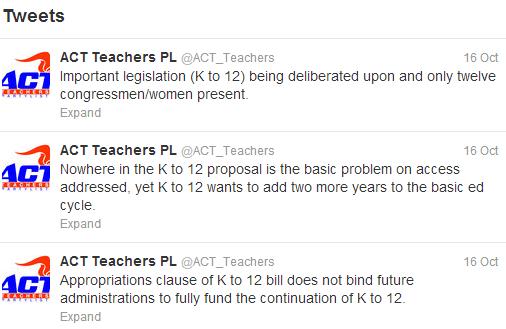
                    Here are some of the recent tweets from ACT_Teachers:


                    And here is the press release from the Alliance of Concerned Teachers:


                    Teachers’ solon slams railroaded OK of K-12 bill on 2nd reading

                    18 OCTOBER 2012

                    PRESS RELEASE

                    ACT Teachers Representative Antonio Tinio lambasted the approval on second reading, without amendments, by the Lower House of HB 6643, the Revised Basic Education Reform Act of 2012, over objections on the lack of preparation for and commitment to fully fund the K to 12 program.
                    Tinio revealed that during committee and plenary deliberations, the bill’s proponents failed to prove that the Department of Education (DepEd) is ready to effectively implement the entire program.  He scored in particular the perennial problems on teacher, classroom, textbook, and other resource shortages which impede children’s access to education.
                    “For the K to 12 reform program to significantly improve the quality of basic education, it must first solve existing shortages.  Sadly, there is no indication anywhere in the bill of the intention to do so,” Tinio lamented.  “With the creation of 61,510 teacher items, the Aquino administration will halve the current teacher shortage but K to 12 proponents failed to show that this en masse hiring will be sustained in the coming years.  And how about the other critical resources?”
                    TInio added that DepEd has not yet fully developed and tested the new curriculum for all the grade levels including Kinder and the additional two years of high school.
                    During plenary debates Tuesday, Tinio argued that the bill’s appropriations clause, a standard provision usually cut-copy-pasted by lawmakers in drafting bills, is insufficient to bind the Aquino and succeeding administrations to fully fund the program.  Instead, the bill’s provisions reveal the intention to let private sector fill up the gaps in public education system.
                    More students will be forced to enrol in private schools due to bloated class sizes, lack of teachers, and others and government will incentivize their admission through subsidies such as GASTPE and the voucher system.  Classrooms, on the other hand, will be built through PPP, proven in other countries to be more expensive in the long run than public funding.
                    “Reliance on these forms of privatization reveals Aquino’s plan to use K to 12 to privatize education, make it more prohibitive for majority of Filipino children, and deprive them of their right to accessible education,” Tinio warned.
                    Tinio feared K to 12 bill’s hasty approval on final reading once session resumes in two weeks, as its proponents did not consider the valid points he and other oppositors raised during committee and plenary debates.  However, he vowed to continue pushing for further preparation and greater funding for any education reform program. 

                    Monday, October 15, 2012

                    Coaching Teachers


                    "Implementing a new curriculum requires strong leadership at the school level. The success of a school depends a lot on the principal. A significant fraction of public schools in the Philippines currently do not have a principal or a head teacher. This clearly needs to be addressed first before any reform in curriculum is initiated. Otherwise, a new curriculum has no hope of being implemented successfully."
                    What happens exactly inside the classroom depends largely on the teacher. There are several factors that influence learning. True enough, there are factors outside the control of a teacher but there are still ways by which a teacher can direct learning both inside and outside the classroom. Teachers.net believes that a teacher can still make a huge difference. Its mission statement is as follows:

                    At Teachers.Net, we recognize that education is a fundamental factor in an individual's prosperity, happiness, contribution to society, and impact on the future. Teachers.Net recognizes the vital role teachers play in education and the betterment of our culture. We also appreciate that teachers are rarely recognized or compensated adequately for their contribution and dedication. 
                    In support of the calling, Teachers.Net was founded on four principles:
                    • To allow our teacher-users to contribute the content and direct site development  
                    • To utilize the Internet to harness the collective intellect and wisdom of the worldwide teaching community
                    • To minimize costs to the greatest extent possible through automation, and 
                    • To never charge teachers for using our resources
                    One recent article by Harry and Rosemary Wong from this website deals with instructional coaching:

                    Downloaded from http://teachers.net/wong/OCT12/
                    The article begins with reminding us of the work of Jacob Kounin. The following are taken from http://en.wikibooks.org/wiki/Classroom_Management_Theorists_and_Theories/Jacob_Kounin:

                    These are the main theories and history of Jacob Kounin.

                    I. "With-it-ness"

                    The teacher is responsible for inhibiting poor behavior. The teacher can maintain this strategy by making eye contact to all students at all times. The teacher should know each student on a personal basis (i.e. name, interests, strength, weaknesses, etc.)The teacher can use other non-verbal techniques to show students that they are alert and care about the well-being of all students. The teacher may also want to make a respectable suggestion to inform the student that their behavior is unacceptable. The teacher should have communicated to all students the expectations and can have these displayed so everyone can be "with-it".

                    II. Overlapping

                    The teacher can have procedures that will allow the teacher to be effective when two situations occur at the same time. For example, if a student is done with an assessment or an assignment early have something for them to do such as moving on to another assignment, reading a book, or a quiet enrichment exercise. While the early-finishers are staying busy the teacher is allowed to move around the room to answer question or assist struggling students. Another example, if the teacher is in the middle of a lecture and a student enters the room the teacher should make eye contact with the student, have an area for the student to turn in work, and continue with the lesson. Once the students are doing their work the teacher can go to the tardy student and tell them what they missed or answer any questions from the homework assigned the night before.

                    III. Momentum

                    The teacher should make lectures short to allow students to group together and move around to gain more knowledge of the content. The teacher should make sure that these exercises remain short so students do not get bored. A teacher can keep a timer and assign roles to students to keep the students moving and on a time deadline. If students are struggling the teacher can reflect on what they can do to make the lesson more meaningful and easier to understand for their students.

                    IV. Smoothness

                    The teacher can have students make hand gestures that will tell the teacher whether the student has a comment or question concerning the lesson. This technique allows the teacher to have an idea of which students may cause an unwanted tangent and which students may have a good question that could pertain to utilizing the time effectively. When placing students in group-work the teacher can walk around facilitating and listening to discussions of other students. The teacher can then intervene or take the group to a different track if the teacher feels it is necessary.

                    V. Group Focus

                    The teacher can implement this strategy with several techniques:
                    A. Encourage Accountability: Make students aware that they will be graded for their participation and contributions to the group. 
                    B. The teacher can have a canister of popsicle sticks that have each students name on them. The teacher can pick the popsicle stick at random to keep students on track and out of their seats with anticipation for question/answer time, board problems, etc. 
                    C. The students can facilitate a discussion. Once they have finished a task they can turn to each other or they could pair up with those who are already done and compare answers.
                    In order for implementation to be effective the teacher must be well organized, communicate their expectations to their students, and hold them responsible for their actions to encourage motivation and attention.

                    __________________________________________________________________________________________________________________________________

                    In other words, Kounin believes that the behavior of a teacher is one important factor that determines student's learning. From this perspective it is straightforward to see how important it is for a teacher to be aware of what he or she does that may significantly influence learning inside the classroom. David Ginsburg, whose work is the subject of the Teachers.Net article states:
                    “School leaders and teachers must always examine how their actions or inactions may be creating barriers or creating enhancements to learning. My work is practical. What matters most is what happens in the classroom. I show them how they can be effective and successful and that is what my coaching is all about."
                    Coaching is different from mentoring. And to elucidate this clearly, a specific example is given by Harry and Rosemary Wong. The example is the story of Emily McGinley, a second grade teacher in Philadelphia. 

                    Teacher Actions
                    (Cause)
                    Student Reactions
                    (Effect)
                    Solutions
                    Emily provided directions orally only and passed out materials before assessing whether students understood the directions.Students played with materials and did not begin the activity until the teacher restated directions to them at their seats.Provide directions visually in addition to orally; assess students' understanding of directions before passing out materials.
                    Emily spent extended time assisting a few students without ever assessing or assisting other students.Some students raised their hands for several minutes, while others socialized.Assign students to collaborative groups with the expectation that they ask each other for help before asking the teacher for help.
                    Emily failed to let students know what to do if they finished the activity early.Students who finished early disrupted those who were still working on the activity.Include in directions for each activity a constructive activity for students to move on to after they finish the first activity.

                    This example illustrates the philosophy of looking at what happens inside a classroom as a cause-effect pairs of events. The behavior of the teacher, what a teacher does is regarded as the cause, and what students do are taken as the effect. The solutions offered by the coach are then direct responses on how a teacher may change his or her strategy to get a better outcome. 

                    In this example, it is pretty clear what coaching really entails. It requires direct observation of the classroom through the eyes of both teacher and students. This is what school leaders do. A school without a head teacher or a principal cannot provide coaching to its teachers. In team sports and even individual ones, an athlete needs an additional pair of eyes for guidance and assessment. This guidance can not come from a remote air conditioned office far removed from where the action is taking place. 

                    “Teachers make countless decisions each day that affect children academically, socially, and emotionally,” says David.  “This is why coaches must observe classrooms through the lenses of students.