Showing posts with label Education Reform. Show all posts

Sunday, November 11, 2012

"From Poverty to Power"

The following is an article posted in a blog by Duncan Green, author of "From Poverty to Power". It describes the "right to education" movement in India in the light of two primary schools, a teachers' group,  and a women's savings club. While thinking about the Philippine situation, I think Green's article is worth our attention:


India’s fight for the right to education


Originally posted on November 9, 2012
http://www.oxfamblogs.org/fp2p/?p=12458


Still processing my recent visit to see Oxfam India’s work – posts continue next week with the great debate on India’s middle classes.
Education is fine example of the strengths and weaknesses of judicial activism in India. The Right to Education (RTE) Act was passed in 2009, arising out of constitutional amendment in 1999 that redefined the right to life as including education (!). Private schools challenged the act, especially its requirement that they reserve 25% of places for lower castes, but the Supreme Court upheld it.
To see what all this means on the ground, I duck out of my boring conference and head for Madanpur,  a colony for slum dwellers ‘rehabilitated’ in 2000 – i.e. their previous homes were steamrollered and they were shunted to the margins of Delhi. Its current population of 145,000 earns income from construction, domestic work etc – almost entirely in the informal economy.Girls shift at the primary school, Delhi
Oxfam India’s partner, the slightly ungrammatical EFRAH (Empowerment for Rehabilitation, Academic and Health) is an RTE activist NGO working with schools to implement the Act – part support, part watchdog (‘they like us, and they are afraid of us’). There is plenty to work on, as the gap between the Act and reality is great: it mandates school management committees with equal teacher/parent representation, but there are none to be seen in Madanpur.
We visit a primary school (up to grade 5, hundreds of kids milling in a tiled playground – right) and catch the headmaster trying to beat a retreat on his motorbike. He reluctantly returns for a few minutes before heading off again, pleading a meeting. We meet the teachers in a hot staffroom with stationary fans – the electric’s been off for 12 hours. They teach 2,500 kids in two shifts – girls in the morning, boys in the afternoon; the teachers claim 80-90% attendance rates, but today it’s more like 60% (they blame the upcoming festival season).
The teachers’ big beef is not wages, but the ‘PTR’ – pupil teacher ratio. There are no classes with less than 50 kids, and many are standing room only. But they acknowledge it was worse before – at least there are more notebooks now.
An aside on service delivery v Oxfam’s ‘rights-based approach’: ‘You keep coming and asking these questions but our lives don’t improve with all these foreign visitors’, say the teachers. ‘Plan India gives us water tanks – but what do you give us?’ But EFRAH says the local government promptly diverted money elsewhere when it heard about Plan’s plan. Service provision certainly makes rights-based work more difficult. ‘Fine, you can come and talk about rights, but what are you going to give us?’
A few streets away, we meet a women’s savings group (left), arrayed in their best saris in a tiny but tidy, sweltering one room house. Their savings group, Delhimain complaint is that they don’t teach their kids anything at the school. ‘Any time you go there, the teachers are not in the classrooms, they are ‘doing paperwork’. The kids are just wandering around. We know there’s not enough teachers, but the ones there are don’t even try to teach. We have to get private classes on top’. All the women are paying for at least some private tuition – $5 per month per subject, all in ‘unrecognized’ private schools which are often no better than the public ones. The women’s big complaint is on the lack of a school management committee or any other source of accountability: ‘they never call us, never call meetings. Teachers and parents need to work together.’ Some parents are filing Right to Information cases to find out how many PTA meetings have been called and who was invited. Another recent RTI case asked how many teachers had been budgeted for, after which the school hired an extra teacher.
Next stop is a group of fifty 13-18 year old girls, in grades 7-10. When we ask what they like about school, there is a resounding silence. Instead, they have complaints – on the lack of toilets, electricity, having to sit on floor. They do like the morning shift though, because it reduces risk of ‘eve teasing’ (sexual harassment). When we ask them how much actual teaching they receive in a 5 hour shift, the average is about 2 hours.
They all want to work (doctors, teachers, police inspectors ‘so I can hit the boys when they harass the girls!’, media) and aren’t under pressure to get married, but ‘We are getting educated, but we can’t work.’ Male relatives stop them going out to work because they’re ‘afraid our character will be put into question’. They insist it’s still better to be a girl ‘we can handle households, children and outside work – but maybe we need to learn karate!’
So it all comes down (doesn’t it always?) to governance and institutions. A combination of increased spending, accountability via school management committees and improved teacher training (it’s largely privatized and ineffectual – recently only 6% of trainee teachers were able to pass a basic test) could turn things around. But that approach is under challenge by contending ‘solutions’ in the shape of privateShashi_Tharoor_WEF public partnerships and the pulling in of the private sector, whose consequences could include increased inequality and exclusion.
Meanwhile the government looks set to kick the RTE can down the road by postponing the deadline for its implementation from 2013 to 2015, underlining the point that in India, getting the law passed is just the start. Implementation is the real battle. Still, the week after my visit, Shashi Tharoor (right), who helped launch the new Indian edition of From Poverty to Power, was made education minister, so let’s hope he takes matters in hand.

Friday, November 9, 2012

Teaching "x = 'why'"

Previously, I shared in this blog the experiences of a Washington Post reporter who went back and spent a year taking high school math. A lot could be learned by returning to the classroom. Having been in a profession offers new perspectives, certainly a new vantage point, to see high school education. These are anecdotes yet useful insights can be drawn from all of these. Another useful immersion has been recently described by Harvey Mudd College professor of mathematics Darryl Yong. Professor Yong spent his recent sabbatical teaching high school math classes in a large urban school district. Yong wrote a wonderful piece describing his experiences as well as his thoughts on this unusual excursion in the Notices magazine of the American Mathematical Society:
http://www.ams.org/notices/201210/rtx121001408p.pdf
The piece illustrates an example of how higher education may be able to help society understand the needs of basic education. For such an immersion to be genuine, it is important that classroom conditions are not altered simply to please a guest lecturer in high school. Otherwise, it defeats the purpose of experiencing first hand what it really means to teach elementary or high school. Professor Yong clearly did not receive special treatment as the following excerpt demonstrates:

...As a final illustration of the kinds of frustration that teachers face, here is an excerpt of a letter I received from my school district a few weeks after the end of the school year.
Dear YONG, DARRYL:
Our records show that you have received an overpayment as a result of a change that was processed in June 2010. The total adjusted gross amount  of your overpayment (reduced by any
retirement contribution) is $12,197.66. This letter is intended to advise you of  your options in repaying the identified overpayment.
The letter was not signed by anyone, there was no contact person listed, and there was no phone number to call! The letter seemed to make it impossible to contest the overpayment; it only listed options for repayment and threatened referral to a collections agency if the amount was not repaid....
Seeing the above proves to anyone without any doubt that this immersion was real and what Yong has to say about teaching in high school reflects a genuine scenario. What he describes in his piece is therefore worth our time. His reflections provide a deeper vision of basic education seen through the eyes of a professor in mathematics. And here are the main points, which he appropriately calls lessons, that he raises in his essay:

  • Basic education schools are complex. Even this is still an understatement. When schools fail, explanations (or excuses) offered are usually too simplistic, thus, depriving society the complete view to address properly the problems. In the Philippines, the old ten-year curriculum described as congested has been pinpointed as the main culprit in the poor state of basic education. The explanation, however, is more of a justification to go to K to 12, than a sincere and in-depth examination of the situation. These are excuses and are no different from knee-jerk comments made by high school teachers regarding how poor they perceive elementary school education is. As Professor Yong writes, "Simplistic diagnoses are dangerous because they encourage quick fixes. Instead of long-term plans for systemic change, school reform becomes a series of short-lived fads that cause teachers to become jaded by unfulfilled promises of improvement." This explains in part why reform after reform, problems in basic education remain. 
  • It helps to have a teacher who has mastery of the subject content but this is no guarantee for high student learning. Yong cites a study made by  Hattie (John Hattie, Visible Learning: A Synthesis of over 800 Meta-Analyses Relating to Achievement, Routledge, 2009.) that shows that a how a student views himself or herself with regard to the subject counts significantly towards the learning outcome in that domain. If a student begins with a perception of weakness in mathematics, this has serious implications on the student's performance in math. Thus, if student's performance correlates with what we perceive as high quality teaching then effective teaching must be able to address and correct a student's preconception of the subject. Perhaps, this is a major difference between an effective and an ineffective teacher. The following excerpt from Yong illustrates this vividly:
I initially spent a great deal of time thinking of fun or creative lessons that would get students excited. These lessons rarely worked because they were often too complicated or inappropriate for my students’ mathematical development. Instead, I began to design my lessons and accompanying student work so that (1) all of my students could successfully complete the first problem or task independently, and in which (2) the sequence of problems/tasks matched my students’ tolerance for challenge and self-concept. 
This strategy not only increased student learning but also eliminated most of the discipline issues in my class and relieved the pressure of having to develop whiz-bang “fun” lessons every day. 
                    • There is a great need to understand correctly what the teaching profession entails. No different from the practice of medicine, the teaching profession is an ongoing learning. Only with the realization of the emotional, physical and intellectual demands of teaching, would society understand and begin to truly respect teachers. If society treats its physicians in a similar manner as teachers are currently treated in the Philippines, for example, one could only wonder what will happen to the quality of health care and medical services.
                    • The last lesson Yong shares is that the "Written curriculum does not matter." What matters is what actually occurs inside the classroom. In this respect, the teacher serves a central role.
                    Yong's experiences are rich with insights and I invite everyone interested in improving the state of basic education to read his article. 


                    Thursday, November 8, 2012

                    Teacher Quality: Getting the Right People to Lead the Classroom

                    Teachers shoulder a great responsibility of molding the future citizens of society. Yet, only a few countries (Finland is one example) demonstrate a highly selective process for teacher education. Teaching schools, for example, are far below medical schools in terms of competitiveness in most places. Raising the quality of teachers will involve two important factors: attractiveness and selectivity. The teaching profession must attract young minds who have the talent and teaching colleges must select only those who qualify. This is the case with the medical profession. And yes, it is perhaps the reason why health care costs are a great deal to any society. To achieve the same with basic education, it will come with comparable costs and priorities. After all, education is as important as health.
                    Marc Tucker, downloaded from http://hechingerreport.org/content/qa-with-marc-tucker-why-we-need-a-new-reform-agenda-to-compete-internationally_5915/
                    Marc Tucker, president of the National Center on Education and the Economy (United States) recently wrote an article, "Teacher Quality: Who's on Which Side and Why", outlining what it takes to make the teaching profession both attractive and selective. Below is an excerpt:
                    ...No one believes that high SAT scores or ACT scores, or high high school grade point averages by themselves guarantee that a candidate will be a good teacher. Everyone I know believes that a passion for teaching and an ability to relate well to young people are very important characteristics of good teachers. But these are not mutually exclusive qualities. The record shows that countries that recruit their teachers from a pool of people who score high on their college entrance exams, had high grade point averages and also show a passion for teaching and an ability to relate well to students produce higher student achievement across the board than countries that leave out one or more of these qualities when they are recruiting their students....
                    In addition to stating what seems to be obvious to many, the article also points out a dilemma faced by teaching colleges when becoming selective thereby connecting issues in higher education with those of basic education. Teaching colleges from the point of view of entrepreneurship do not favor the selectivity requirement to uplift teacher quality. Having less students hurts the bottom line of these institutions. Being highly selective and serving the needs of basic education do not make teachers' colleges profitable.

                    If I may use an analogy, research in the basic sciences can never be funded by the market. Yet, the United States and other developed nations fund research. It is one of the obligations only a government could provide. Thus, on similar grounds, teacher education falls into this category. A government must subsidize if not fully support teaching institutions so that these colleges can be more selective. This is only one of the factors. The other is making the teaching profession attractive. Again, with a public school system, the government is one of the employers of teachers. Salaries and working conditions can dampen without any doubt enthusiasm and dedication. All of these seem obvious but somehow there are some who still think that privatization and free enterprise can provide teacher quality. No, only a government representing the society as a whole that is genuinely committed to uplifting the teaching profession can.

                    Friday, November 2, 2012

                    While the Philippines Moves to Spiral Approach, Missouri Does the Opposite

                    School districts in the state of Missouri are changing their science curriculum for Grades 6 to 8. The reform primarily changes science instruction from a spiral approach to a field-focus curriculum. The Philippines, on the other hand, with DepEd's K to 12 goes in the opposite direction. Without debating which direction is the correct one to take, both need to face the challenge of a major transition. Poor implementation of an education reform leads to failure even if the change is the correct prescription. A major part of the implementation is the transition stage, which is crucial for the success of the reform. It is therefore necessary to pay close attention to the transition process as this stage can easily lead to failure if not implemented correctly. Missouri's efforts are assisted by institutions of higher learning within the state. One is Lindenwood University.
                    The Spellman Clock Tower of Lindenwood University reflecting its view on education
                    One dissertation from Lindenwood University tackles specifically the transition of Missouri school districts to the new science curriculum: 
                    http://gradworks.umi.com/3450281.pdf
                    Abstract 
                    This investigation examined the transition from a spiral science curriculum to a field-focus science curriculum in middle school. A spiral science curriculum focuses on a small part of each field of science during each middle school year, more of a general science concept. In contrast to that, the base of a field-focus curriculum is that each grade level focuses on a specific field of science, more of a high school like concept. The literature reviewed provides a history of science education, the steps of the change process, and the importance of professional development. The literature review provided a basis for determining trends in the science education. 
                    The researcher collected a variety of data to understand the process that districts move through to transition to a field-focus science curriculum. Interviews provided information concerning the transition process of three Midwestern school districts that have arranged their curriculum into a field-focus alignment. Teacher surveys of one district supplied the perceptions of the professional development involved during the transition process. The researcher also examined school district student achievement data in the area of science. 
                    Suggestions made through this investigation focused on the Eight Steps to a Successful Change when implementing a field-focus science curriculum alignment. Following the suggested steps will help a transition go smoother.
                    This study specifically looks at the New Heart School District in the state of Missouri. The science teachers in this district have agreed to abandon the spiral approach and adopt a field-focus approach to teaching science. The rationale was simple - surrounding school districts that have instituted this reform are doing better in statewide standard exams. The following are among Alwardt's findings regarding the transition New Heart School District undertook:
                    • Transition is always difficult so it is important that evidence supporting the reform is shared. In this particular case, data supporting the notion that a spiral approach leads only to a superficial treatment of topics and does not prepare students for the the rigor expected in standard tests.
                    • Communication is vital between supervisors and teachers. These need to be regular so that updates and concerns are immediately addressed.
                    • All necessary materials required for the new curriculum are promptly provided to all teachers. This effectively alleviates tension and anxiety toward the new curriculum.
                    As Alwardt emphasizes, "Transitions are inherently difficult for teachers." While trying to adjust to the change, teachers still have the obligation to give the very best instruction to the students. There are no "dress rehearsals". It is therefore very important that teachers during this stage are heard and supported. With these in mind, one can evaluate how DepEd in the Philippines is implementing its K to 12. One should understand and appreciate the crucial role of teachers in education reform.

                    Saturday, October 27, 2012

                    Finding What Works in Education

                    Pasi Sahlberg wrote the following sometime ago in the Washington Post:
                    "...many education visitors to Finland expect to find schools filled with Finnish pedagogical innovation and state-of-the-art technology. Instead, they see teachers teaching and pupils learning as they would in any typical good school in the United States. Some observers call this “pedagogical conservatism” or “informal and relaxed” because there does not appear to be much going on in classrooms. 
                    The irony of Finnish educational success is that it derives heavily from classroom innovation and school improvement research in the United States. Cooperative learning and portfolio assessment are examples of American classroom-based innovations that have been implemented in large scale in the Finnish school system."
                    The above quote is echoed in the following initiative launched recently in the Unites States:

                    http://www.odysseyinitiative.org/

                    And here are some examples the program has seen so far:

                    Rethinking Classroom Structure
                    New American Academy
                    Posted on October 24, 2012 by Michelle Healy
                    In a time when educational budgets are crunched around the country, the topics of classroom size and teacher to student ratio are highly debated topics in the educational and political spheres. What number is best for the students and the teachers in the room? 
                    At The New American Academy in Crown Heights, Brooklyn, school leader Shimon Waronker and the faculty have designed a new approach to class structure: 60 kids, 4 teachers, and one large, open classroom. 
                    The four teachers are generally made up of one master teacher, two partner teachers, and one associate teacher. Master teachers have often been curriculum coordinators or coaches before, and act as the senior mentor in the group. Partner teachers have a couple years of teaching experience, and associates are generally first or second year teachers. This structure was designed to provide an in-classroom career ladder and as well as daily chances for mentoring, feedback, reflection and collaboration between the master teacher, partner teachers, and associate teacher....
                    Moving Mountains Through Strong, Trusting Relationships
                    Crockett Elementary School
                    Posted on October 22, 2012 by Todd Sutler

                    David Crockett Elementary School is a public school in the Balsz District in Phoenix, Arizona. Crockett serves approximately 500 students from diverse backgrounds in kindergarten through 6th grade. Over 95% of the students at Crockett qualify for free lunch, and all students have access to fresh fruits and vegetables through a federal grant. Principal Jarret Sharp is leading his “crew” toward a curriculum that is relevant and rigorous for all students. The Balsz District has added an additional 20 days of instruction to their school year, which leads to an additional year of instructional time by 8th grade. 
                    “You can make the most impact through relationships. Knowing the details with parents, the kids and the staff makes all the difference in the world. It is a lever to move heavy duty things on a campus. If you can build strong, trusting relationships, you can move mountains.” Principal Jarrett Sharp has taken the practice of building relationships within his school community to another level. He uses the “details” he knows about the different stakeholders to help them make the learning experience as positive and productive as possible for his students....

                    Helping Students Teach One Another Math LIGHTHOUSE COMMUNITY CHARTER SCHOOL

                    Posted on October 4, 2012 by Michelle Healy

                    Lighthouse Community Charter School is a K-12 public school in Oakland, California. The mission is “to prepare a diverse, K-12th grade student population for college and the career of their choice by equipping each child and youth with the skills, knowledge, and tools to become a self-motivated, competent, lifelong learner.” Lighthouse is designed around five principles: High expectations for all students, a rigorous curriculum, serving the whole child, family involvement, and creating a professional learning community. In addition to being rigorous, the curricular approach is also authentic, hands-on and inquiry-driven. All students at Lighthouse are taught to advocate for themselves and are able to articulate their strengths and learning goals. 
                    When Laura Kretshmar of Lighthouse Community Charter School in Oakland, California, told her sixth graders that they were going to have a number talk, smiles, claps, and “Yessss!” were heard from the students as they waited in anticipation. Laura invited students to share expectations for number talks and move closer and sit on the carpet if they needed to.
                    In Laura’s classroom, number talks are short, strategic conversations that focus on flexible mental problem solving as well as strategy sharing and critiquing. Strings of related equations are used to help students see patterns and help them transfer strategies from one equation to the next....
                    And there are many more examples.

                    And as Pasi Sahlberg from the best educational system in the world had shown, there maybe a lot to learn from these....

                    Saturday, October 20, 2012

                    What Does Science Tell Us About Teaching Kids to Think?

                    This is the same title of an article that came out in The Atlantic early this month. It was written by University of Virginia psychology professor Daniel Willingham. The article was in fact a response to another piece entitled "The Writing Revolution" by Peg Tyre in The Atlantic that talked about a school in Staten Island called New Dorp:
                    For years, nothing seemed capable of turning around New Dorp High School’s dismal performance—not firing bad teachers, not flashy education technology, not after-school programs. So, faced with closure, the school’s principal went all-in on a very specific curriculum reform, placing an overwhelming focus on teaching the basics of analytic writing, every day, in virtually every class. What followed was an extraordinary blossoming of student potential, across nearly every subject—one that has made New Dorp a model for educational reform.
                    Willingham then writes:

                    The history of education is littered with flavor-of-the-month interventions, many of which began at a model school, but that, once implemented elsewhere, flopped. Dejected educators then begin scouting for the next "big thing." 
                    There is, but implementing it correctly is no small matter.In this instance, a heavy emphasis on writing seemed to make kids better writers, better readers, and perhaps, better thinkers. What does published research say? Is there any reason to expect that a writing curriculum, if implemented in other schools, would bring the same benefits?

                    Asking the above questions is very important. These are the questions that any Department of Education must ask before embarking on any large-scale reform. And the answers lie in performing well-controlled experiments and publishing the results in a peer-reviewed journal so that experts could evaluate the work. If the questions have been addressed before by others, then a careful examination of published studies can be useful. Willinghan then points us to an article published in the Journal of Educational Psychology to gain further insights on how teaching students how to write could improve learning:
                    Downloaded from http://psycnet.apa.org/psycarticles/2012-18075-001.pdf
                    To understand the above paper, it is important to know what effect size (ES) means. In this particular work, ES measures the effect of a particular intervention on the performance of the students. For example, the average score of students who were exposed to the additional teaching component is compared to those who did not receive the treatment. This difference is then compared against the standard deviation of either population. An ES close to 1 indicates a highly significant effect. It means that students who have received a particular intervention are scoring one standard deviation higher than students who have not. One standard deviation in grading is usually the separation between "average" and "above average". An ES of 1 essentially means that the intervention brings the student's performance from mediocre to the top 20%. With these statistical analyses of previous studies, it then becomes possible to zero in on the interventions that have significant effect on student learning. The authors of the above paper are then able to make the following recommendations:
                    • Teach students strategies for planning, drafting, or revising different types of text (ES=1.02)
                    • Teach students procedures for regulating the writing strategies they are taught (ES=0.50)
                    • Teach students how to form images and be more creative (ES=0.70)
                    • Teach students how different types of text are structured and formed (ES=0.59) 
                    • Teach students spelling, handwriting, and keyboarding (ES=0.55)
                    • Develop instructional arrangements where children work together to plan, draft, revise, and edit their papers (ES=0.89)
                    • Set clear and specific goals for what students are to accomplish when writing (ES=0.76)
                    • Engage students in activities that help them gather and organize ideas for their papers before they write a first draft (ES=0.54)
                    • Assess students’ writing and progress learning to write (ES=0.42)
                    • Make it possible for students to use word processing as a primary tool for writing (ES=0.47)
                    • Increase how much students write (ES=0.30)
                    • Implement a comprehensive writing program (ES=0.42)
                    Still, the authors add the following cautionary statement:
                    Just because a writing practice was effective in multiple research studies does not guarantee that it will be effective in all other situations. Rarely, if ever, is there a perfect match between the conditions under which the writing practice was implemented in the research studies and the conditions in which it was subsequently put to use in classrooms. Even if there was a good match, the safest course of action is for teachers implementing the writing practice to monitor its effects to be sure it works in their classrooms with their students.
                    And Willingham ends his article with the following:
                    And this is why I say that the New Dorp results are likely replicable, but we must pay close attention to what happened there. It's easy to remember only that "they asked the kids to write a lot." But as Tyre describes, they placed an intense emphasis "on teaching the skills that underlie good analytical writing." There was explicit teaching of writing, and the emphasis was on analysis. I would add that this instruction must be paired with substantive content in order to pay dividends in critical thinking. 
                    To read more articles on how to teach writing visit http://www.theatlantic.com/debates/education:

                    Downloaded from http://www.theatlantic.com/debates/education

                    Thursday, October 18, 2012

                    ACT Representative on DepEd's K to 12

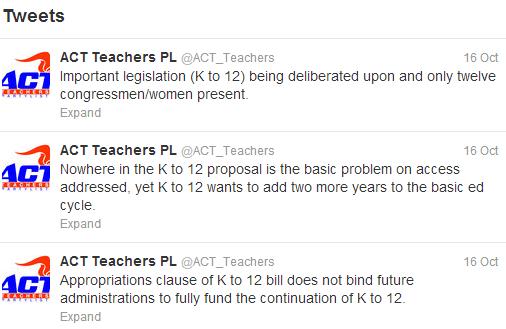
                    Here are some of the recent tweets from ACT_Teachers:


                    And here is the press release from the Alliance of Concerned Teachers:


                    Teachers’ solon slams railroaded OK of K-12 bill on 2nd reading

                    18 OCTOBER 2012

                    PRESS RELEASE

                    ACT Teachers Representative Antonio Tinio lambasted the approval on second reading, without amendments, by the Lower House of HB 6643, the Revised Basic Education Reform Act of 2012, over objections on the lack of preparation for and commitment to fully fund the K to 12 program.
                    Tinio revealed that during committee and plenary deliberations, the bill’s proponents failed to prove that the Department of Education (DepEd) is ready to effectively implement the entire program.  He scored in particular the perennial problems on teacher, classroom, textbook, and other resource shortages which impede children’s access to education.
                    “For the K to 12 reform program to significantly improve the quality of basic education, it must first solve existing shortages.  Sadly, there is no indication anywhere in the bill of the intention to do so,” Tinio lamented.  “With the creation of 61,510 teacher items, the Aquino administration will halve the current teacher shortage but K to 12 proponents failed to show that this en masse hiring will be sustained in the coming years.  And how about the other critical resources?”
                    TInio added that DepEd has not yet fully developed and tested the new curriculum for all the grade levels including Kinder and the additional two years of high school.
                    During plenary debates Tuesday, Tinio argued that the bill’s appropriations clause, a standard provision usually cut-copy-pasted by lawmakers in drafting bills, is insufficient to bind the Aquino and succeeding administrations to fully fund the program.  Instead, the bill’s provisions reveal the intention to let private sector fill up the gaps in public education system.
                    More students will be forced to enrol in private schools due to bloated class sizes, lack of teachers, and others and government will incentivize their admission through subsidies such as GASTPE and the voucher system.  Classrooms, on the other hand, will be built through PPP, proven in other countries to be more expensive in the long run than public funding.
                    “Reliance on these forms of privatization reveals Aquino’s plan to use K to 12 to privatize education, make it more prohibitive for majority of Filipino children, and deprive them of their right to accessible education,” Tinio warned.
                    Tinio feared K to 12 bill’s hasty approval on final reading once session resumes in two weeks, as its proponents did not consider the valid points he and other oppositors raised during committee and plenary debates.  However, he vowed to continue pushing for further preparation and greater funding for any education reform program. 

                    Wednesday, October 17, 2012

                    Do Schools Teach Students Not to Study Effectively

                    Students in Finland do not have to take standardized exams. During the first years of education, students normally receive verbal assessments and not numerical or letter grades. The decision when to start handing out numerical grades rests on each school. Children do not grow up counting points as measures of their achievement. It then becomes clear that the main purpose of going to school is to learn and not to earn high marks. This difference can have a dramatic impact on the not just on the attitude of the students but more importantly, on the true learning accomplishments of the students.

                    Placing emphasis on exams and grades can shape how a student manages his or her time and attention. A focus on scores places certain dates throughout the school year as more important than the rest. Reviewing for exams can become more important than being actively engaged in each and every lecture and classroom activity. The same holds true for projects and reports. Without paying attention to spacing evenly the tasks required for these activities, there is a strong tendency to squeeze all of these into the last minute. Procrastination and cramming are not the worse outcomes, however. The scores in exams may not reflect the bitter truth, but on a deeper level, students may in fact be failing to learn.

                    In the most recent issue of Child Development, the flagship journal of the Society for Research in Child Development, there is an article that examines the effects of sleep deprivation on student's performance:
                    Downloaded from http://onlinelibrary.wiley.com/journal/10.1111/(ISSN)1467-8624/earlyview


                    The entire paper can be downloaded from https://www.sleepdoc.com/pdf/study%20or%20sleep.pdf
                    Learning in school is an everyday task. Tests inadvertently distill the school year into a few dates. Emphasis on grades conditions the minds of pupils to a pragmatic view on schooling. What really matters becomes reduced to a small fraction of the time the student spends in school. There are many more hours spent inside the classroom but what determines the final outcome happens only during the exam or in a submission of a final project. What happens along the way is lost.  The above study is important for it also demonstrates that it is counterproductive. 

                    There are other reasons why Finland's schools may be performing better than schools in other countries but with certainty, a misplaced emphasis on grades and exams is one reason that can hold back a school from fulfilling its potential to become a genuine place for learning.

                    Sunday, October 14, 2012

                    Staying in School

                    "Most countries have only ten years of compulsory education. Compulsory education in the US varies from state to state, but the average requires anyone who is under 16 years of age to be either enrolled in a school or home-schooled. This means that on average, the US only has 10-11 (including kindergarten) years of compulsory education. The last two years in the US K-12 education already include courses in tertiary education. These are called advanced placement (AP) or international baccalaureate (IB) courses. Examples are calculus (up to multivariable) and AP chemistry. Students who take AP chemistry usually have already finished one year of basic chemistry and one year of advanced chemistry, so in sum, a student could have taken three years of chemistry while in high school. Some schools in the US can not offer these, and consequently, there is great heterogeneity among US schools."

                    Compulsory education requires responsibility from two sides: the learner and the provider. Requiring a given number of years of basic education without providing the resources is plain wrong. In addition, compulsory means a strong and determined implementation of a requirement. In the Philippines, kindergarten is now compulsory. Unfortunately, all that this means is that a student can not be enrolled in Grade 1 without completing kindergarten first. Compulsory education in the United States means someone goes to prison if a child fails to attend school. Of course, a government is only justified to take such action if the government provides all the necessary resources to attend school. When my son reached 5 years of age, I received a phone call from our school county board asking why my son has not attended the public school in our neighborhood during the first week of the school year. I had to inform the authorities that I had already enrolled my son in a Catholic school. This is what compulsory education seriously means. 

                    In the past few weeks, the Hamilton project at the Brookings Institution hosted the following forum: Back to School: Promoting Attainment and Achievement in K-12 Education. One of the papers presented in this forum is from graduate student Derek Messacar and associate professor Philip Oreopoulos from the University of Toronto:


                    Downloaded from http://www.hamiltonproject.org/files/downloads_and_links/THP_MessacarOreopoulos_CompSchool_DiscPaper_1.pdf

                    Abstract
                    High school dropouts fare substantially worse than their peers on a wide variety of long-term economic outcomes. On average, a dropout earns less money, is more likely to be in jail, is less healthy, is less likely to be married, and is unhappier than a high school graduate. But despite this growing education gap, dropout rates have remained mostly unchanged over the past three decades. This problem disproportionately affects low-income and minority students: among these populations, nearly half of all individuals do not graduate with their class. This paper presents a plan to increase the high school graduation rate. A key element of the proposal is for all states to increase their minimum school-leaving age to eighteen. In many studies, this intervention has been found to have a significant positive impact on several long-term outcomes. The proposal also calls for more resources for enforcement of new and existing compulsory-schooling laws, to maximize the impact of the policy change. More effort is also needed to keep students engaged in school, even at an early age. If states invest in effective support programs, they can further increase graduation rates and reduce future costs of enforcing compulsory-schooling policies. All of these interventions should be implemented with the goal of strengthening America’s primary education system to promote college attendance and improve career outcomes among America’s youth. 
                    The paper begins with enumerating how school dropouts affect society as a whole.  School dropouts generally face higher unemployment and a significant fraction fall below the poverty line. In the United States, school dropouts by the age of fifty earn on the average $16.50 an hour, working in construction, food services, and truck transportation. Teenage birth rates are also high for school dropouts. The rate of school dropouts also strongly correlates with the crime rate in a neighborhood as well as the overall economic standing of the community. It is with this realization that it becomes apparent the true costs of school dropouts, reminding us of the old adage, "If you think education is expensive, try ignorance."

                    The problem becomes more serious with the fact that remediation is almost an impossible task. Compulsory education does come with costs. Even with adequate resources for schooling, implementing compulsory education requires personnel, time and effort. The fact that I received a phone call on the year that my son was supposed to start schooling meant someone in the government was in fact paying attention. School dropouts do not happen overnight. Thus, compulsory education requires monitoring and keeping records.

                    Past grade school and across the mid teen years, as the child further develops his or her own decision making, compulsory education now has to deal directly with the student. At this stage, compulsory education not only requires schools to use "sticks" but also "carrots" to reengage students who may have the impulse to leave school without fully understanding the long lasting consequences of such action. 

                    To apply the above thoughts on the Philippine situation is very painful. First, peer-reviewed studies are required to find out why students stop attending school. The reasons maybe obvious but a careful study is still required. Poverty is expected to be the top reason. Child labor is widespread. Classrooms are overcrowded. The high pupil to teacher ratio prevents teachers from establishing a deeper one-on-one relationship with their students. The fact that public schools are not really free makes it difficult for poor parents to send their children to schools. 

                    To address the above problems, of course, there are costs. Providing free lunch to poor students, ensuring that public schools do not collect any fees (no exceptions), providing the poor with the necessary school supplies and learning materials, reducing the pupil to teacher ratio especially in schools where most students come from poor families - all of these measures require money. It is quite obvious that resources are not there for thirteen years of compulsory education. So we need to take baby steps, "first things first".  We should not overextend ourselves for this will only exacerbate the situation. Doing well in the early years of education will equip students with skills and interest to continue in their education. Resources in basic education can be focused on these early years.

                    The costs are actually very small compared to the costs of not taking these actions. School dropouts are correlated with crime rate, drug use, early pregnancy, and poor health. School dropouts lead to a less engaged citizenry. Democracy simply can not flourish in an uneducated society. The "straight path" cannot be achieved by simply removing the corrupt from the halls of power in the Philippine government. The "straight path" requires education for all, an education that equips each and every member of society. Thus, we end with the familiar saying: "If you think education is expensive, try ignorance."

                    Wednesday, October 10, 2012

                    As Senate Debates DepEd's K to 12

                    It is in the news (Philippine Star): The Senate of the Republic of the Philippines has started debating DepEd's new K to 12 program.

                    Senate starts debates on K+12 
                    By Marvin Sy (The Philippine Star) Updated October 09, 2012 12:00 AM 

                    MANILA, Philippines - The Senate has started plenary debate on a bill seeking to increase the number of years in the country’s basic education or the K-to-12 program.

                    Sen. Edgardo Angara, chairman of the Senate committee on education, arts and culture, sponsored Senate Bill 3286 yesterday, which he said would enhance the curriculum so the Filipino student would be better prepared for higher education.

                    “They will be prepared for higher education, middle-level skills development, employment and entrepreneurship,” Angara said.

                    _______________________________________________________________________________

                    Unfortunately, the likelihood that the discussion in the Senate will be framed within an evidence-based approach is close to nil. Angara already notes that the change in curriculum is not new and that consultations have been made throughout the entire country.

                    As the Senate debates DepEd's K to 12, I wish senators would first read an article by Professor Paul Thomas of Furman University where he talks about how education reform in the United States has been missing the correct approach to education reform. Thomas' important points are:
                    • Standards have never worked and never will.
                    • Student poverty is a very strong factor.
                    • Teacher quality is not a major factor to student learning, but society's treatment of its teachers is.
                    DepEd's K to 12 fails to address these important points. Upgrading of teachers' salaries still has not won the attention of the Philippine government. DepEd's K to 12 focuses more on the curriculum and number of years, which are not the important factors in student's learning. DepEd's K to 12 does not address the poverty and hunger faced by millions of Filipino children. And most importantly,

                    "Public education has failed historically and currently because educators have never run our school system...

                    ...Because "reform" has been a political football; not a process of scholarship, research and implementation by educators."

                    Photo downloaded from Daily Kos: Faux Education Reform or Improved Education
                    _________________________________________________________________________________

                    Here's the article:

                    U.S. public education appears in dire need of reform. To address that problem central to the health of America's democracy and economy (reformers note), committees must be formed and solutions proposed and then implemented:
                    "That it is expedient to hold a conference of school and college teachers of each principal subject which enters into the programmes of secondary schools in the United States and into the requirements for admission to college—as, for example, of Latin, of geometry, or of American history—each conference to consider the proper limits of its subject, the best methods of instruction, the most desirable allotment of time for the subject, and the best methods of testing the pupils’ attainments therein, and each conference to represent fairly the different parts of the country."
                    This committee constituted of university presidents and school leaders set out to answer the following questions:
                    "1. In the school course of study extending approximately from the age of six years to eighteen years—a course including the periods of both elementary and secondary instruction—at what age should the study which is the subject of the Conference be first introduced?
                    2. After it is introduced, how many hours a week for how many years should be devoted to it?
                    3. How many hours a week for how many years should be devoted to it during the last four years of the complete course; that is, during the ordinary high school period?
                    4. What topics, or parts, of the subject may reasonably be covered during the whole course?
                    5. What topics, or parts, of the subject may best be reserved for the last four years?
                    6. In what form and to what extent should the subject enter into college requirements for admission? Such questions as the sufficiency of translation at sight as a test of knowledge of a language, or the superiority of a laboratory examination in a scientific subject to a written examination on a text-book, are intended to be suggested under this head by the phrase 'in what form.'
                    7. Should the subject be treated differently for pupils who are going to college, for those who are going to a scientific school, and for those who, presumably, are going to neither?
                    8. At what stage should this differentiation begin, if any be recommended?
                    9. Can any description be given of the best method of teaching this subject throughout the school course?
                    10. Can any description be given of the best mode of testing attainments in this subject at college admission examinations?"
                    Is this an initiative from the U.S. Department of Education led by Secretary Duncan? A committee formed by the governors to help schools implement Common Core State Standards? A committee funded by the Gate Foundation? A move endorsed by Michelle Rhee, Wendy Kopp (TFA), or the KIPP charter chain?
                    But it certainly is similar to any reform movement concerning education since then and including now.
                    The reform movement must be examined against two issues: (1) What is the status quo of education and education reform? and (2) How might we re-imagine the "public" in public education?
                    The Education and Reform Status Quo
                    Central to the potential effectiveness of reform is an essential process: identify the status quo, evaluate the status quo, and then change the elements of the status quo that are clearly failing. For education reform to change our schools directly and our society indirectly, we must first identify the status quo; thus, what are the elements of the educational status quo as well as the status quo of education reform?
                    • Identifying "high" standards for K-12 to insure college and work readiness is the status quo. Common Core State Standards can be traced back to the Committee of Ten; identifying standards, raising standards, and implementing new standards have never worked, and never will.
                    • Aligning standardized testing to those standards is the status quo. The Committee of Ten identified needed testing, and then standardized testing exploded in the early to mid-twentieth century. More and better tests have never worked, and never will.
                    What is not a part of the status quo (or the problem with education)?
                    • Unionization is not uniform or present throughout the U.S.; thus, unions are not part of the status quo. Heavily unionized states often have the highest student outcomes, while non-union states have some of the lowest outcomes. Relative student poverty is a much stronger status quo than unionization.
                    • Teacher quality is not central to or a major element in student achievement; thus, teacher quality is not part of the status quo needing urgent reform. But teacher assignment is part of the status quo since affluent students are assigned the most qualified and experienced teachers while children of color and children living in poverty are assigned new and unqualified teachers.
                    Current education reform elements being endorsed and implemented by the reformers with power and money are, in fact, perpetuating the status quo, and are in effect the exact opposite of reform.
                    Driven by more than a century of the same education policies and reforms, public schools face the exact same issues confronted in every decade since the late nineteenth century.
                    Re-Imagining (Not Rejecting) the "Public" in Education
                    In the education reform movement during the past thirty years of accountability and high-stakes testing, the U.S. has failed to identify the status quo, and has ironically perpetuated the status quo—entrenching deeper and deeper the social inequity the public schools reflect.
                    Universal education is a public good that should serve to correct the historical and current failures of society, such as economic inequity, racial injustice, and gender inequity. For public education to be a corrective public institution, then, public schools must be publicly funded but not politically managed.
                    Public funding is essential for basic aspects of a culture, such as a road system, a judicial system, a police force, a military, and the most important foundational system, schools. [The U.S. ignores the foundational nature of healthcare, however.]
                    Yet, when public institutions fail, that failure is not due to the public aspect of the institution but because of the failure to create a wall between public funding and partisan political bureaucracy.
                    Public education has failed historically and currently because educators have never run our school system.
                    Public funding of education, in order to reform education and overcome the failures of the status quo, must be implemented at every level of schooling—from the Secretary of Education to each teacher in every classroom—by qualified and experienced educators and scholars. Not by appointees, not by presidents, not by governors.
                    Then, instead of technocratic (and misleading) accountability policies imposed on education by partisan politicians, those professional educators must serve the public transparently while remaining committed to outcomes that support democracy, equity, and the public good.
                    Partisan political bureaucracy de-professionalizes education and creates a constant cycle of starting over with the exact same policies in different packages.
                    Common Core State Standards, high-stakes testing for student and teacher accountability, charter schools, and Teach for America are slightly new packages for the status quo—not reform that changes schools so schools can change society.
                    Let's start there and re-imagine the "public" in education.

                    ORIGINALLY POSTED TO PLTHOMASEDD ON TUE OCT 02, 2012 AT 07:52 AM PDT.

                    ALSO REPUBLISHED BY EDUCATION ALTERNATIVES.

                    Tuesday, October 2, 2012

                    Education to Get Ahead?

                    An infographic packs a great deal of information and presents it in a visual manner clearly and quickly. The following is an example courtesy of fastcodesign:

                    Infographic: How The Poor Spend Their Money Vs. The Middle Class
                    Downloaded from 
                    http://www.fastcodesign.com/1670463/infographic-how-the-poor-spend-their-money-vs-the-middle-class
                    The above shows how American families are spending. The sizes of the circles are drawn according to what fraction is spent for a particular item. Families are grouped according to the household income. Circles are pretty much the same size suggesting for example, that poor families rent or live in small houses while the rich are spending the same fraction, but from a bigger salary, so the wealthy are living in bigger houses. The same goes with clothes as well as eating out so the rich must be dressing up in fancier clothes and going to more expensive restaurants. The circles are not of the same size for "food at home", "utilities", "transportation", and "health care" where the poor spends a greater fraction, and for education and investments, where it is the opposite, that is, the rich is spending a bigger fraction. In absolute terms, the rich are actually still spending more on food at home. With poor families, the basic needs are simply taking a bigger fraction of their income. For the items where the circles are larger for rich families, there is even a much more dramatic difference. In dollars, a poor family spends about $250 a year on education while a rich family spends a minimum of about $7000, thirty times more than a poor family. This difference becomes even more striking in spending on savings for retirement (investments). One important take home message from this infographic is that Americans view education as an investment.

                    How does this picture apply to the Philippines? The differences are only magnified. Social services in the United States are arguably at a much higher level than they are in the Philippines. In schools, there is either free lunch or meals at subsidized prices. School supplies are provided, for health care, there is Medicaid, and for the poor, there are food stamps. The poor in the Philippines could barely afford to send their children to schools even though there are no tuition fees because of school supplies, transportation, and meal costs. Using education to get ahead is much more dramatic. There are elite schools from preschool to high school where tuition fees are definitely not within the reach of the majority of the society. These elite schools have far better resources. And the system is self-perpetuating. Education in these elite schools provide students with a head start. Social connections are made likewise and kept within a small segment of society. Alumni from these schools will fare better in society and become the next wealthy generation. These rich alumni will of course donate back to their alma mater further increasing the gap between the schools for the rich and the schools for the poor. The situation is not as dire yet in the United States. But when Finland's education expert, Pasi Sahlberg, education as a means for getting ahead is one of the key features noted that makes it difficult for the United States to achieve the same success as Finland did. Anu Partanen talks about this in the following article:

                    What Americans Keep Ignoring About Finland's School Success

                    ANU PARTANEN - Anu Partanen is a Finnish journalist based in New York City. She is writing a book about what America can learn from Nordic societies.
                    DEC 29 2011, 3:00 PM ET

                    The Scandinavian country is an education superpower because it values equality more than excellence.

                    Excerpts:
                    For Sahlberg what matters is that in Finland all teachers and administrators are given prestige, decent pay, and a lot of responsibility. A master's degree is required to enter the profession, and teacher training programs are among the most selective professional schools in the country. If a teacher is bad, it is the principal's responsibility to notice and deal with it. 
                    And while Americans love to talk about competition, Sahlberg points out that nothing makes Finns more uncomfortable. In his book Sahlberg quotes a line from Finnish writer named Samuli Paronen: "Real winners do not compete." It's hard to think of a more un-American idea, but when it comes to education, Finland's success shows that the Finnish attitude might have merits. There are no lists of best schools or teachers in Finland. The main driver of education policy is not competition between teachers and between schools, but cooperation.
                    Finally, in Finland, school choice is noticeably not a priority, nor is engaging the private sector at all. Which brings us back to the silence after Sahlberg's comment at the Dwight School that schools like Dwight don't exist in Finland. 
                    "Here in America," Sahlberg said at the Teachers College, "parents can choose to take their kids to private schools. It's the same idea of a marketplace that applies to, say, shops. Schools are a shop and parents can buy what ever they want. In Finland parents can also choose. But the options are all the same." 
                    Herein lay the real shocker. As Sahlberg continued, his core message emerged, whether or not anyone in his American audience heard it. 
                    Decades ago, when the Finnish school system was badly in need of reform, the goal of the program that Finland instituted, resulting in so much success today, was never excellence. It was equity.

                    Education reform in the Philippines likewise will only work if the Philippines recognizes this important perspective from Finnish educators. The Philippines not only ignores what the Finnish system does, but actually does the opposite. DepEd's K to 12 begins with a similar aspiration: 
                    We need to add two years to our basic education. Those who can afford pay for up to fourteen years of schooling before university. Thus, their children are getting into the best universities and the best jobs after graduation. I want at least 12 years for our public school children to give them an even chance at succeeding. My education team has designed a way to go from our current 10 years (6 elementary, 4 high school) to a K-12 system in five years starting SY 2011-12. Kindergarten (K) to Grade 12 is what the rest of the world gives their children.
                    The intentions are in the right direction. What then is sorely missing? The quality of education is not in the number of years. The quality is provided by what Sahlberg notes above: 
                    ...in Finland all teachers and administrators are given prestige, decent pay, and a lot of responsibility. A master's degree is required to enter the profession, and teacher training programs are among the most selective professional schools in the country. If a teacher is bad, it is the principal's responsibility to notice and deal with it....
                    What makes a good school good? Do not look anywhere else. The answer is simple: Teachers. When teachers are underpaid, overworked and dictated, a spectrum of schools will naturally happen: Good schools and bad schools. Worse, there will be very few good schools and a lot of bad schools. When there are good and bad schools, education becomes a simple market place. Those who could afford to send their children to good schools will do. Those who could not have no choice. Philippine basic education in its current state sustains and magnifies inequities in society.  "The Scandinavian country is an education superpower because it values equality more than excellence."