Showing posts with label Teacher Groups. Show all posts

Tuesday, November 6, 2012

The American Federation of Teachers


The Blue Ribbon Campaign

 "Access to free, quality education is both a human right and part of the essential foundation for economic growth in every nation," said Randi Weingarten, President of the American Federation of Teachers. "With this toolkit, students and educators in the United States help give a voice—and hope—to the millions of children around the world who still seek access to quality education."
—Randi Weingarten, AFT president
blue ribbon The American Federation of Teachers is a partner in the Global Campaign for Education, United States Chapter—the international coalition of faith groups, non-governmental organizations and trade unions supporting access to quality basic education for every child in the world by 2015. As we campaign in state capitals and school districts to protect quality education for children in the United States, we are mindful of the 72 million children in the world who do not have a classroom or teacher. With our partners in the GCE-US, the AFT is leading the Blue Ribbon Campaign in the United States, a grass-roots effort to build an understanding that education is the key to economic development, social stability and vibrant democratic governance.

Get Involved

Join the Blue Ribbon Campaign. Add to the national blue ribbon chain by mailing your links to: Global Campaign for Education, U.S., 750 First Street NE, Suite 1040, Washington, D.C. 20002. The chain will be included in a press event to mark the introduction of the Education For All Act.

Classroom Activities

AFT members across the nation are taking the campaign’s Lesson for All teaching activities into their classrooms and local community organizations, to focus attention on children in disadvantaged parts of the world who don’t have access to a quality education. Our teachers and students are creating links in the national blue ribbon chain (see Blue Ribbon Campaign classroom activity), and they are joining with others around the world, calling on politicians and policymakers to stand up for the right to a free and quality primary school education.
AFT members are integrating the Lesson for All activities into their classroom plans to help American children understand why education is so important, and what challenges disadvantaged students face when they lack access to quality schooling. This year’s Global Action Week theme focuses on the importance of education for girls and women in developing countries. The activities show students how they can bridge the gender gap and ensure girls have a fair chance at all life’s possibilities.

Take Action

Write to your U.S. representative and ask him or her to join with Reps. Nita Lowey (D-N.Y.) and Dave Reichert (R-Wash.) in sponsoring the Education for All Act.

Tuesday, October 23, 2012

Teachers Want More Funds to Education


NEWS RELEASE October 23, 2012

Teachers Dignity Coalition

The Teachers’ Dignity Coalition (TDC) on Monday hails the declaration from the Budget Department that it has released the funds amounting to P2.68 billion allotted for the construction of school buildings and water and sanitation facilities for public schools. The group believes that such amount could augment the needs of public schools for the improvement of physical facilities.

“While it is quite late, because we are in the final quarter, construction and repair of school buildings, classrooms and toilets could really enhance the learning environment of our children. A place conducive for learning yields better performance.” Said Benjo Basas, a Caloocan City teacher and the group’s national chairperson.

Basas however criticized the government for allotting very little funds for education sector in 2012 and in the proposed 2013 national budget.

“If the government is sincere in its “globally competitive” programs like K-12, there should be more money for education sector. The kindergarten program should have been prioritized.” Basas said.

Basas cited the implementation of the K-12 program which for his group’s belief lacks integral support especially in resources.

“The government is focused on curricular reform, yet the shortage in teachers has reached its historic high. We need basic necessities to attain the ambitious goals of K-12 program, the Aquino government’s flagship program in education.” Basas continued.

While the group appreciates the efforts of the DepEd in improving education performance, it is still critical to implementation of the K-12 program. Last week, House’s education committee overwhelmingly approved the K-12 proposal.

“If we expect the best output, we should also be providing the best input.” Basas ended

Thursday, October 18, 2012

ACT Representative on DepEd's K to 12

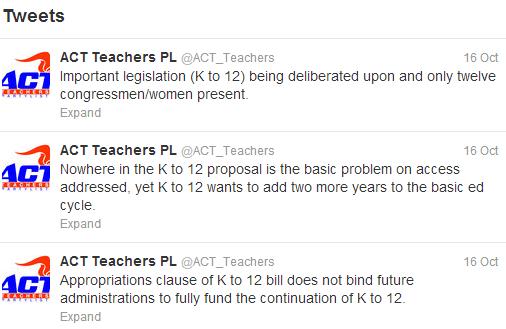
Here are some of the recent tweets from ACT_Teachers:


And here is the press release from the Alliance of Concerned Teachers:


Teachers’ solon slams railroaded OK of K-12 bill on 2nd reading

18 OCTOBER 2012

PRESS RELEASE

ACT Teachers Representative Antonio Tinio lambasted the approval on second reading, without amendments, by the Lower House of HB 6643, the Revised Basic Education Reform Act of 2012, over objections on the lack of preparation for and commitment to fully fund the K to 12 program.
Tinio revealed that during committee and plenary deliberations, the bill’s proponents failed to prove that the Department of Education (DepEd) is ready to effectively implement the entire program.  He scored in particular the perennial problems on teacher, classroom, textbook, and other resource shortages which impede children’s access to education.
“For the K to 12 reform program to significantly improve the quality of basic education, it must first solve existing shortages.  Sadly, there is no indication anywhere in the bill of the intention to do so,” Tinio lamented.  “With the creation of 61,510 teacher items, the Aquino administration will halve the current teacher shortage but K to 12 proponents failed to show that this en masse hiring will be sustained in the coming years.  And how about the other critical resources?”
TInio added that DepEd has not yet fully developed and tested the new curriculum for all the grade levels including Kinder and the additional two years of high school.
During plenary debates Tuesday, Tinio argued that the bill’s appropriations clause, a standard provision usually cut-copy-pasted by lawmakers in drafting bills, is insufficient to bind the Aquino and succeeding administrations to fully fund the program.  Instead, the bill’s provisions reveal the intention to let private sector fill up the gaps in public education system.
More students will be forced to enrol in private schools due to bloated class sizes, lack of teachers, and others and government will incentivize their admission through subsidies such as GASTPE and the voucher system.  Classrooms, on the other hand, will be built through PPP, proven in other countries to be more expensive in the long run than public funding.
“Reliance on these forms of privatization reveals Aquino’s plan to use K to 12 to privatize education, make it more prohibitive for majority of Filipino children, and deprive them of their right to accessible education,” Tinio warned.
Tinio feared K to 12 bill’s hasty approval on final reading once session resumes in two weeks, as its proponents did not consider the valid points he and other oppositors raised during committee and plenary debates.  However, he vowed to continue pushing for further preparation and greater funding for any education reform program. 

Thursday, October 4, 2012

Celebrating World Teacher's Day


On UNESCO's homepage:

World Teachers' Day 2012: Take a stand for teachers!


http://www.unesco.org/new/en/unesco/events/prizes-and-celebrations/celebrations/international-days/world-teachersday/


To celebrate World Teachers' Day, here are some YouTube videos to watch. They provide stories of lives of Philippine teachers:
  • ACT@30 years
  • A Rainy Day Rally
  • Good Morning Teacher
  • "The Learning: Philippine Teachers in Baltimore"
  • Guro: Stories of Hope, Dedication and Courage
And at the end there are videos from Singapore and Finland. But first, an infographic on Teachers in the Philippines:

Let us get to know more about the Filipino public school teacher as we celebrate them this October 5, 2012 for Teachers' Day.
-Ryan de la Cruz, 
High School Social Studies Teacher · Muntinlupa City
http://www.facebook.com/ryanbdelacruz28

ACT @ 30 years: The History of the Militant Teachers' Movement in the Philippines


Teachers' Dignity Coalition (TDC) National Chair Benjo Basas in a rainy mayday rally in Morayta, Manila for teachers' pay increase.
"This film will take you to a poignant journey in a teacher's life in a certain public school. It will give you a glimpse of the sacrifices and challenges a teacher faces in a society where reality bites hard. The film gives us hope and a fleeting assurance that things can get better if we have passion and extreme love in what we do."

"In the new documentary, "The Learning," filmmaker Ramona Diaz follows four Filipina women facing their first year as teachers in Baltimore's public schools. This excerpt is part of The Economist Film Project, a series of independently produced films aired in partnership between The Economist and the NewsHour."

Carlos P. Romulo Foundation for Peace and Development in cooperation with the Foundation for Information Technology Education and Development (FIT-ED) presents this documentary on the Filipino teacher.

"2011 commercial by MOE (Ministry of Education) Singapore.
Teachers are mentors and role models to their pupils. They influence young minds and inculcate sound social and moral values through word and deed, within and outside the classroom. They must impart to pupils learning skills, thinking skills and life skills to cope with the future; an attitude of continuous learning and improvement; and a sense of commitment and belonging to Singapore."
http://www.youtube.com/watch?v=l48FyAmQNOc

"Heljä Misukka, the Secretary of State for Education, told euronews: "What is also maybe quite special in Finland is that teachers are quite autonomous in what they do, so they can, for example, choose the materials they like or the pedagogy they use. They have a lot of freedom in their work.""

Saturday, September 22, 2012

Martial Law: Teachers and Professors Who Fought the Dictatorship

Here are the teachers and professors whose names are enshrined on the Wall of Martyrs and Heroes at the Bantayog ng mga Bayani. The pictures and the captions are from the Bantayog ng mga Bayani Foundation. A Martial Law Posters' Exhibit will be on at the Bantayog from Sept 20 until the end of September.
Downloaded from : ActPhils Facebook page, http://www.facebook.com/actphils


Wednesday, September 12, 2012

Chicago Teachers Strike while Philippine Teachers Continue to Work

Hundreds of thousands of children in the city of Chicago suddenly have no classes to attend. Parents found themselves scrambling to find alternative childcare arrangements so that they could go to their work. This is what snow days do to us in Virginia. School closings can have a dramatic impact on our schedules. But public schools are not closed in Chicago due to a snowstorm. The teachers went on strike. The main reason behind the strike is the school board's plan to use students' test scores in standardized exams as a major part of teacher's evaluation. Chicago teachers on the average receive more than US$6000 per month. The school board even promised a 16% raise over the next four years.

More than 200,000 Chicago pupils qualify for the free lunch program. This means that a large number of these pupils will not be having the nourishment they normally receive when schools are closed. These numbers are likewise used to support the teacher's opposition to the use of standardized test scores. Teachers have pointed out that learning outcomes measured by these standard tests are heavily influenced by poverty. Children from poor families perform poorly in these exams not necessarily due to poor teaching.

Philippine public school teachers receive a much lower (at least 10 times lower) salary. Kindergarten volunteer teachers receive about US$70 per month (that is almost 100 times lower). Classrooms in the Philippines are not air-conditioned. Teachers in the Philippines deal with students who are sometimes have nothing to eat. Yet, these teachers have not stopped working.

Perhaps, this gives us more reason to start listening to the teachers in the Philippines:


And instead of staging a strike, they dance to demonstrate:

Photo downloaded from  http://www.facebook.com/actregion7union

Sunday, September 9, 2012

Kasama Ako ng Mga Butil ng Kanin


by Jayson Cruz on Friday, September 7, 2012 at 5:29pm ·

Tula ng pakikiisa sa TDC Boodle Fight na ginanap sa Senado noong Setyembre 5, 2012

Kasama ako ng mga butil ng kanin
sa hapag na inyong kinainan.
Sa ulam na tuyong pinagsaluhan
nang pait ng dusa ng ATING mga GURO
sa ilang dekadang nakaraan.

Sambungkos na talbos,
adobong paa ng manok,
maalat na itlog,
nanguluntoy na nilagang talong
at samboteng bagoong.
Muling pinaalulong
ang namamaos nating tinig,
Muling pinaimbulog
ang pinagsamasamang lakas,

ang mga nagngangalit na ugat sa ating leeg,
pumarada muli, mga maong na kupas
mga kamaong gigil, muling itinaas,
sabay-sabay na isinisigaw nang ubod-lakas

DIGNIDAD NG GURO, WAG LAPASTANGANIN!

Kasama ako ng mga butil ng kanin
na isinubo ng mga butuhang kamay
sa magdamag na naglalamay
sa pagbalangkas ng leksiyon ng sangkatauhan,
paghubog ng ugali ng mga kabataan.

Kasama ako ng mga butil ng kanin
sa katawan ninyo'y nagpalakas
sa harap ng Senado, tanghaling tapat.
Sama-sama ninyong hinagilap
hinarap,
ipinakiusap
ang daing ng ATING mga GURO
kahit pagod na sa pagtuturo
patuloy ang pakikipagdayalogo
makamtan ang panalo,
maitaas ang pasahod sa mga guro.

Kasama ako ng mga butil ng kanin
na ating pinagtitiisan
sa matagal na panahon na pakikibaka
sa buhay at kamatayan,
sa kasiyahan at kasawian,
sa kalakasan at kahinaan.

Kasama ako sa mga butil ng kanin
hanggang sa maipanalo ang laban
nang lahat ng mga guro'y makinabang
ang tunay na mga bayani ng bayan!

NOTE:

SA MGA KASAMA KO SA TDC-NCR,

Ipagpaumanhin ninyo na hindi ako nakasama sa isang makabuluhang pagkilos na ito. Inaapoy ng lagnat ang aking anak at kailangan ako sa tabi niya. Pinagturo ko na ang misis ko dahil wala na siyang service credit at ako'y mayroon pa naman. Bunga ng instant noodles (na pambansang ulam nating mga guro) ang pagkakaroon ng UTI ng aking anak. Patunay lamang ito na hindi sapat ang pasahod na ating tinatanggap mula sa pamahalaan na atin namang pinaglilingkuran nang tapat.

Sa tingin ko'y dapat lamang nating isigaw ang MAKATARUNGANG PASAHOD PARA SA MGA BAYANI NG BAYAN!

Kaisa ninyo,

Jayson Alvar Cruz

Friday, September 7, 2012

Honoring Teachers

This is not the transcript of the speech delivered by former US president Bill Clinton on the Wednesday evening of the Democratic National Convention, but it carries a logic similar to:

"What new ideas did we bring to Washington? I always give a one-word answer: arithmetic." 
- Bill Clinton
This speech also addresses failed policies that politicians seem to embrace over and over again, expecting different results. As Clinton smartly quipped, "We simply can't afford to double down...." 

This speech is about honoring public school teachers in the Philippines. Education reforms that do not alleviate the working and living conditions of teachers will fail. Improving learning outcomes in Philippine basic education must place teachers' rights and welfare on the very top of the list of things to do. No one I hope will argue against thanking our teachers. Yes, there are good teachers and there are not so good teachers. But obviously (as clear as 1+1 = 2) teachers cannot do their job well if we do not enable them. Without addressing their rights and welfare, their vocation to serve our youth is seriously compromised. "We will simply reap what we sow."

Here is a transcript of Rep. Antonio Tinio's privilege speech on the National Teachers' Month.


4 September 2012 
This coming Wednesday, September 5, marks the opening of National Teachers’ Month, declared in 2011 per President Aquino’s Proclamation 242, to “celebrate the unique role and service” of teachers.  “To express sincere gratitude for teachers,” DepEd has advised its regional and division offices and students to give “thank you” cards, free makeover and spa treatments, discounts, or freebies to teachers, also to hang streamers and hold contests to honor teachers, from September 5 to October 5. 
The culminating date, October 5, is celebrated all over the world as Teachers’ Day to mark the adoption on that day of the Recommendation concerning the Status of Teachers in 1966 at a special intergovernmental conference convened by ILO and UNESCO in Paris.  For nearly forty-six years, the Recommendation has served as the international frame of reference for standards on the rights and welfare of teachers, including adequate remuneration, stability of employment and security of tenure, and conditions for effective teaching—on such issues as class size, hours of work, school rooms, and the like. 
Who would say “no” to an entire month of tributes, free spa, discounts, “thank you” cards, or a grand celebration in one’s honor?  But Madam Speaker, my dear colleagues, I invite you to approach any teacher, and ask him or her: How do you like to be thanked?  The most meaningful way of commemorating National Teachers’ Month, the most sincere expression of gratitude for our children’s second parents, is by giving full effect to their rights—to living salary, adequate remuneration, stability of employment and security of tenure, professional advancement, union rights, among others. 
While the Executive branch says, “Let’s thank teachers,” it seems its show of gratitude ends with “thank you” cards and a “grand celebration.”  The DepEd budget is proposed at P231.4 billion under the proposed General Appropriations Act for 2013, the highest appropriation in all departments.  While this looks rosy for the education sector, the President and the Aquino administration merely continues the trend of inadequate funding for education.  Since at least 2004, the government has not given DepEd a budget higher than 1.98% of the GDP, or 11.8% of the total national budget.  Next year, DepEd’s budget is only 1.92% of GDP and 11.53% of the total P2.006 trillion national budget.  Since this inadequate budgetary allocation translates to measly salaries and shortages in critical resources down to the smallest schools, teachers bear most of its impact. 
President Aquino vowed to create, by June next year, 61,510 new teacher items.  We must give credit where credit is due; we laud this unprecedented move of the creation of a massive number of new teacher items.  Normally, in previous years, the national government would only fund 10,000 to 14,000 new items, so this is indeed very welcome and long overdue, as the public school system has long been beset by extreme teacher shortages.  However, we must take issue with the following statement made by the President in his 2013 budget call.  Let me quote: 
“We also aim to fully cover the shortfall in quality public school teachers by allocating P13.4 billion for the creation of 61,510 teaching positions.”
In particular, we take issue with the statement that by 2013, the shortage of teachers will be fully covered.  The fact is, in spite of the creation of this unprecedented number of teaching items, it will still not cover the shortfall of 49,530 teaching positions which are funded by the local government, nor will it cover the shortfall of over 23,000 volunteer Kindergarten teachers employed by DepEd through contracts of service.  So, in other words, far from solving the issue of teacher shortages by 2013, there will remain a shortage of at least 64,000 teachers by 2013. 
The proposed budget by 2013 is in fact still unfortunately marred by the policy of contractualization in the teaching profession.  Beginning school year 2011-2012, DepEd hired, as I said, volunteer Kindergarten teachers.  This school year, the volunteers number around 23,000 and they all receive an “honorarium” which forces them to live within a budget of as low as P100 a day.  They are paid from P3,000 to P6,000 per class per month, remuneration which is unconscionably low considering the P425-minimum wage in NCR and the unchecked increases in the prices of basic needs of the ordinary family.  They also do not enjoy benefits normally received by regular teachers of the national government, nor do they have security of tenure, much less do they have the right to form and join unions. 
Several rights of public school teachers are threatened by this practice, so we strongly urge the Aquino administration to abandon this policy of placing public school teachers in precarious employment through contracts of service.  We call on the administration to allocate sufficient Personal Services funds under the DepEd budget for their immediate regularization.  But pending that, we also urge Aquino to immediately increase the monthly honoraria of volunteer Kindergarten teachers from P3,000 per class per month to at least P6,000 per month.  So, in other words, we call for a doubling of these honoraria. 
Contractualization is even more prevalent in state universities and colleges.  According to last year’s budget hearing, when asked how many new teaching items will be created for all these state universities and colleges for 2013, the answer given by CHED is that there will be zero new items created for 2012.  That is also true for 2012.  In fact, the trend has been in a reduction in the number of full time faculty positions in state universities and colleges. In 2002, the Philippine Normal University had 385 faculty positions, but next year, it will only have 383.  From 2003 to the present, the six SUCs of MIMAROPA collectively lost 106 faculty positions, and the eleven SUCs in Western Visayas lost 70.  On the other hand, enrolment in these regions, as well nationally, increase year by year by around 3,200 and 8,400, respectively at an average of 75,700 students yearly nationwide.  So in other words, the trend has been the reduction in regular faculty positions in SUCs while enrolment has been increasing.
Because the numbers of regular faculty cannot keep up with the increase in enrolment, SUCs resort to hiring contractual faculty out of savings or to the hiring of several part-timers out of the budget for one regular teaching item.  Again, these teachers, called part-time teachers, receive less than their full-time counterparts despite the fact that they all take the same teaching loads and responsibilities, with no benefits and no security of tenure. 
Now, we move on to salaries.  The total personal services budget of DepEd and the SUCs for 2013 have no room for salary increases.  With the implementation of the last tranche of SSL3, teachers in basic and tertiary education, along with non-teaching personnel in public schools, are worried that their salaries will remain stagnant despite the unceasing rise in the cost of living.  Will we see a repeat of the previous experiences regarding public sector pay where, after the implementation of SSL, there will follow several years of a “salary freeze” for our public sector employees?  We certainly hope not. 
Teaching and non-teaching personnel also expect no supplement to their meager salaries, in the form of benefits or incentives.  President Aquino has allotted P9.9 billion for a system of performance-based bonuses for 2013, but its implementing rules, among them Executive Order 80 and DBM Memorandum Circular 2012-01, banned any increase in the rates of existing bonuses and the grant of new bonuses.  We view these executive issuances as attacks against the rights of teachers and other civil servants to adequate remuneration and other means of job satisfaction and fulfilment, particularly to their right to collective negotiation. 
This brief review of state policies as embodied in the national budget pertaining to teachers and the education sector shows that the Executive could do much more to show gratitude to our teachers and to educators.  Starting this Wednesday, teachers will be hearing DepEd and the President saying “thank you” for an entire month, but they will feel no sincere gratitude from the government for the coming year.  Teachers still receive a starting salary of P18,549 monthly or Salary Grade 11, a compensation incommensurate to their vital roles in society.  They still have to manage oversized classes up to 70 to 90 students each, with two, three, even four sessions each day.  An increasing number of them are unsure if they would still be hired as teachers once their contracts end, on top of the anxiety caused by very low honoraria.  They will discover that their union rights, which they have begun to enjoy only recently, will be severely diluted with their inability to negotiate for bonuses to supplement their salaries. 
In this coming World Teachers’ Month, this representation urges the Executive and Legislative branches in the strongest terms:  Stop the systematic denial of teachers’ rights.  Immediately enact legislation that answers the teachers’ legitimate demands, among them House Bills 2142 for the upgrading of teachers’ salaries from Salary Grade 11 to Salary Grade 15 and HB 3746 for a P6,000 increase in the basic pay of public employees. 
On 15 December 2011, this Congress took one significant step forward in expressing gratitude for teachers by approving on third reading HB 4097, “An Act Declaring October 5 of Every Year as ‘National Teachers’ Day’.”  Today, I urge you, my colleagues, to take a more significant step further.  Let us approve the aforementioned House Bills, and like-minded bills and resolutions on the rights and welfare of teachers in the soonest possible time, and convince our colleagues at the Senate that enacting laws that protect teachers’ rights and welfare is the best way of to commemorate World Teachers’ Day. 


Wednesday, September 5, 2012

Celebrating Teachers' Month

The following are banners from Facebook pages of the Alliance of Concerned Teachers, Teachers' Dignity Coalition and National Teacher's Month.


National Teachers' Month

by Benjo Basas
PILIPINO MIRROR COLUMN, September 5, 2012 

Ngayong araw na ito, September 5, 2012 ay ang pasimula ng isang buwang pagdiriwang ng National Teachers’ Month. Ito’y ikalawang taon pa lamang ng pagdiriwang na ito simula nang lagdaan ng Pangulong Aquino ang Presidential Proclamation No. 242 noong nakalipas na taon. Ang pagdiriwang ay magtatapos sa araw ng Oktubre 5- ang siya namang araw na ipinagdiriwang sa mundo bilang World Teachers’ Day (WTD) alinsunod sa deklarasyon ng UNESCO noong 1994. Ang buong buwan ay inlaan ng ating pamahaalan partikular ng Department of Education (DepEd) sa pagbibigay-pugay sa ating mga guro. Maraming mga aktibidad ang nakatakdang gawin mula sa mga paaralan, hanggang dibisyon, lungsod at lalawigan, panrehiyon at maging pambansa- lahat sila ay gagawin upang ipaalala sa ating mga kabataan at sa lahat ng mamamayan ang kalahagahan ng ating guro. Noong mga nakalipas na taon ay masugid kaming mga guro- lalo na ang Teachers’ Dignity Coalition (TDC) sa pagtutulak na ideklara ang Octobner 5 bilang special holiday. Para sa amin, kung mayroong Mayo Uno na pandaigdigang araw ng manggagawa at isa sa mga opisyal na holiday sa bansa, dapat ay mayroon ding araw para sa pagkilala sa mga guro. May ilang panukala na rin ang naisumite hinggil dito ngunit hindi pa rin ito tuluyang naisasabatas. Sa ibang mga bansa sa Soutrh East Asia ay nagpasimula ang opisyal na pagdiriwang ng Teachers’ Day noon pang 1956 sa Malaysia, 1957 sa Thailand at 1958 sa Vietnam. At nito ngang nakalipas na taon, samanatrala isang araw lamang ang aming hinihingi ay isang buwan ang ibinigay sa amin ng pamahalaan. Signipikante ang WTD sa lahat ng guro sa buong mundo, sapagkat sa ganitong araw din noong 1966 nang lagdaan ng mga bansang kasapi ng UNESCO at ILO ang Recommendations Concerning the Status of Teachers na siyang naging batayan ng lahat ng bansa kung papaano tratuhin ang kanilang mga guro. Ang instrumentong ito rin ang naging batayan ng pagsasabatas noon ding 1966 ng RA 4670 o Magna Carta for Public School Teachers, na siyang itinuturing na Bibliya ng mga guro sa Pilinas. Nagpapasalamat kami sa ating pamahalaan sapagkat sa wakas ay pormal na niyang kinilala sa pamamagitan ng isang legal na dokumento ang pagdiriwang ng Araw ng mga Guro, noon kasi’y token celebrations lamang ang isinasagawa tuwing Oktubre 5. Subalit, higit sa pagkilala sa pamamagitan ng proklamasyon, mas dapat patunayan ng ating pamahalaan na pinahahalagahan niya ang ating mga guro sa pamamagitan ng pagbibigay ng sapat na panganagilanagan sa sistema ng edukasyon upang maibsan na ang matagal nang suliranin sa mga kakulanagan sa guro, klasrum, upuan, aklat at iba pa. Dapat nang itaas ng Pamahalaang Aquino ang budget sa pampublikong edukasyon. Higit sa lahat, dapat nang bigyan niya ng prayoridad ang kanyang mga guro sa pamamagitan ng mas makatarungang pasahod, mas maraming mga benepisyo at maayos na kalagayan sa kanilang trabaho. Ito ang tunay na pagpapahalaga sa mga bayani, ayon nga sa tema ng National Teachers’ Month: MY TEACHER, MY HERO. #
TDC at the gates of Senate. Preparing for boodle fight

DepEd Budget for 2013

The following are slides taken from a PowerPoint Presentation of the Alliance of Concerned Teachers ( http://www.act-teachers.com/act-proposed-budget-for-2013/ ). The original presentation contains an arithmetic error on the budget item on Maintenance and Other Operating Expenses (MOOE). The figures shown in this blog have been corrected. It is shared here to emphasize the dramatic shortfall of the proposed DepEd budget for 2013. It illustrates why implementation of K to 12 is poorly timed when there are currently so much needed yet unanswered in basic education.

The proposed DepEd budget for 2013 is 
PhP 293,200,000,000.

And here is DepEd's take on its proposed budget:

DepEd: No more classroom, teacher shortage next year 
By Jess Diaz 

"...Luistro said the proposed P293.2-billion DepEd budget for next year includes more than P13 billion for the hiring of 61,510 new teachers and 3,500 non-teaching personnel.
He said the new teaching personnel would include more than 7,000 teachers who volunteered for the kindergarten program that was started this year. 
Luistro said 17,939 classrooms would be built, along with 90,461 new water, toilet and sanitation facilities. 
Some 31 million learning materials would be procured and distributed to public schools nationwide, he added. 
He pointed out that the teacher hiring and classroom construction programed for 2013 would be sufficient for the requirements of the public school system...."

Monday, September 3, 2012

Celebrating Teachers' Month with Bell Ringing Day and Picket-Protest

Press Release:Teachers open Teachers’ Month with a coordinated Bell Ringing Day& Picket-protest on DepEd’s 2013 budget hearing
by Act Phils on Sunday, September 2, 2012 at 11:18pm ·

September 3, 2012
Press Release

Teachers open Teachers’ Month with a coordinated Bell Ringing Day and Picket-protest on DepEd’s 2013-budget hearing

As proposed, the Department of Education having been appropriated P292.7 Billion will again get the biggest chunk in the proposed P2.006 trillion national budget for 2013.

“Pnoy and DepEd boast that education always gets the biggest pie or allocation in our national budget but what is amiss here?” Ms France Castro, Secretary-general of ACT asked. “Pnoy mentioned grand reforms in education during his SONA but again his “empowerment budget” skirted major demands from our end, Ms. Castro, added.

For teachers nationwide, the meager salary of teachers remains one of the most pressing concerns confronting Philippine education that Aquino must address. Entry-level teachers are receiving only P18,549 ($441.64) a month under the Salary Standardization Law 3. “This is demoralizing to many teachers, who are supposedly considered as ‘professionals’ yet receiving a salary which is way below the P957 ($22.065) daily family living wage in the National Capital Region”, Ms France Castro said.

Pnoy also promised to fully cover the shortfall in quality public school teachers by allocating P13.4 billion for the creation of 61,510 teaching positions to include the regularization of 7,967 kindergarten volunteer teachers.

“But we are not applauding Pnoy’s grand promises. He will hire teachers to fill the gaps but he is not ready to pay teachers with decent salaries. In real terms, he is considered “teacher’s enemy no.1“these days for a good reason. Pnoy has ignored our dialogues in the past and have categorically said, that there will be no salary increases during his term,” Ms. Castro emphasized.

“But we will not let things pass as he wishes. If Pnoy is really is serious to honor teachers this World Teachers Month, then he must simply look back and read and act on our demand: SG 15 for teachers now! and give the teachers what is due to them,” Ms Castro ended.###

Reference: Ms. France Castro, Secretary General, Cellphone No. 09178502124
Mr. Benjie Valbuena, Vice-Chairperson, Cellphone No. 09182399222
Media Liaison – Zenie Lao, Cellphone No. 09198198903


Thursday, August 30, 2012

A Letter to Principals

TO OUR BELOVED ADMINISTRATORS AND PRINCIPALS

Dear Sir/Madam:

Warm Greetings!

On September 3, 2012, Monday, the budget for Basic Education will be presented for deliberation at the House of Representatives. This is an important event for all of us.

We are united in the education sector that there should be a significant increase in the budget for education. This increase should fill up the shortages in teachers, school buildings, classrooms, sanitation facilities, books, chairs and other needed school facilities. This should also correspondingly lead to additional MOOE, living allowances and to the upgrading of our salaries. ACT believes that these are essential factors for quality education to be realized in our country.

That is why on September 3, 2012, Monday, ACT is requesting and encouraging you and your teachers and personnel to join in our “Bell Ringing Moment” for 15 minutes (12:00 to 12:15 noon time). This shall be our main form of campaign that will eventually unite us as we struggle for our demands. This unity will be a major key to our success.

Thank you very much and more power to you!

Sincerely yours,

MR. BENJAMIN VALBUENA
Vice-Chairperson
ACT-Philippines

Friday, August 3, 2012

Pahayag ng Alliance of Concerned Teachers


Aquino ipinapagtuloy ang "dekada ng pagpapabaya" ni GMA sa sektor ng edukasyon!  K to 12 hindi solusyon, Ibasura!


Pahayag ng Alliance of Concerned Teachers
July 23, 2012 

Grabeng paglala sa krisis ng edukasyon ang idinulot ng walang kaparis na pagpapabaya dito ng nakaraang rehimeng Macapagal-Arroyo. Ito ang minana ng administrasyong Aquino kay GMA. Tinawag ito ng Aliance of Concerned Teachers (ACT) na "Nawaldas na Dekada" ng kawalan ng pag-unlad at lalong pagkabulok ng edukasyon sa Pilipinas.

Hinamon ng  mga guro at kawani ng sector ng edukasyon at sambayanang Pilipino  si Aquino na tuparin ang kanyang mga pangako na sa  kagyat ay maglunsad ng mga hakbang upang mabawi ang nawaldas na dekadang ito at magsagawa ng mga pundamental na reporma sa buong sistemang pang-edukasyon.  Nararapat lamang na bigyan ng pangunahing tuon ang pagiging abot-kamay ng lahat ang edukasyon.

Pinakamayor sa ating mga hamon ang pangangailangan  na dapat  talikuran ang mga patakarang neoliberal ng denasyunalisasyon, pribatisasyon, deregulasyon, at liberalisasyon sa edukasyon. Kailangang tiyakin ang katangiang pambansa, siyentipiko at pangmasa ng edukasyon para sa mamamayan .Inihanay din natin  natin ang mga prayoridad sa larangan ng edukasyon na dapat harapin ni Pangulong Aquino

Bigyan ng pinakamataas na prioridad sa pambansang badyet ang edukasyon ayon sa nakasaad sa Saligang Batas.

Tiyakin na makatatapos ng elementarya at hayskul ang lahat ng kabataan.

  • Ipatupad ang libreng preschool para sa lahat.
  • Doblehin ang bilang ng mga hayskul sa buong kapuluan.

Gawing abot-kaya ang edukasyon sa antas kolehiyo.

  • Itigil ang pribatisasyon at komersyalisasyon ng mga State Universities and Colleges.
  • Paglaanan ang mga ito ng sapat na pondo.
  • Ipatupad ang regulasyon sa mga pribadong paaralan.

Punuan ang mga kakulangan sa guro, klasrum, libro, at iba pang rekursong pampaaralan. Isulong ang edukasyong pambansa at siyentipiko

Palakasin  ang pagtutuo ng makabayang kasaysayan at kultura at paglilingkod sa sambayan sa kurikulum, at  Itaguyod ang paggamit ng  wikang Filipino at mga lokal na wika at isulong ang angkop na paraan ng pagtuturo

Iayon ang sistema ng edukasyon sa mga pangangailangan ng pambansang industriyalisasyon at modernisasyon ng agrikultura.
Itaguyod ang karapatan at kagalingan ng mga guro at kawani sa edukasyon.

  • Itaas sa Salary Grade 15 ang mga pampublikong guro at itumbas dito ang suweldo ng mga pampribadong guro.
  • Pondohan nang sapat at ipatupad ang Magna Carta for Public School Teachers.
  • Irespeto ang  job security ng kaguruan. Ipatupad ang mahigpit na regulasyon sa kontraktwal-isasyon sa sektor ng edukasyon.

Itigil ang mga pampulitikang pamamaslang! Ibasura ang Oplan Bayanihan

Hustisya para kina Napoleon Pornasdoro, Vitoria Samonte, Mark Francisco, at iba pang biktima ng paglabag sa karapatang pantao!

Napakalinaw ng nilalaman ng Agenda ng Mamamayan sa Edukasyon. Nakatuntong sa katotohanan ang husga ng mga guro at ng sektor sa edukasyon kung bakit bagsak ang ibinigay na grado kay Aquino sa pagtatapos ng ikalawang taon ng kanyang  panunungkulan bilang Pangulo  Sa mga kritikal inputs sa edukasyon, lumala pa ito dahil sa programang  K to 12 na mali ang oryentasyon, minadali , walang kalidad at dagdag na pahirap sa esensya.

Ang pwersahan at iresponsableng pagpapatupad ni PNoy ng K to 12 ay pagsunod lamang sa mga dikta ng dayuhang monopolyong bangko, korporasyon at gobyerno sa larangan ng edukasyon. Patuloy ang krisis sa shortages sa bilang ng mga teachers, classrooms, chairs, textbooks, instructional materials, water & sanitation facilities, atbp. na ibayong pinalala ng pwersahan at iresponsableng pagpapatupad ng K to 12 ni PNoy.

Mula sa pinakahuling tala ng Alliance of Concerned Teachers (ACT), 132,483 ang kakulangan sa teachers, 97,685 ang tinatayang kakulangan sa classrooms, at 153,709 ang kakulangan sa mga sanitation facilities ngayong akademikong taon.

Ngayung  2012, naglaan ang rehimeng Aquino ng P239 bilyon para sa DepEd, katumbas ng P7/araw para sa isang estudyante. Sapat lamang ito para tugunan ang 27% ng pangangailangan para sa bagong mga klasrum, 20% ng kakulangan ang mahigit P100 bilyon na kinakailangan para sa dagdag na gastos para sa programang K to 12.

Ang net elementary participation rates ay patuloy na bumagsak mula sa 90.1% noong 2002 pababa sa 88.1% nitong 2010. Ayon mismo sa DepEd, mula sa 100 Grade 1 students, 66 lamang ang nakakatapos at 58 lamang ang nakakapasok sa high school; 43 lamang ang nakakatapos ng high school at 23 ang nagtutuloy sa kolehiyo, samantalang 10 ang kumukuha na lang ng vocational. 14 mula sa 23 college students at 7 lamang sa 10 vocational students ang makakapagtapos.

Ibayo ring palalalain ng K to 12 ang unequal access to education sa pagitan ng mahirap at mayaman. Noong 2007, sa elementary ay 91.8% ang participation rate mula mayayamang pamilya, samantalang 85.9% naman mula sa mahihirap na pamilya; sa high school naman ay 76.5% mula sa mayayamang pamilya, habang 51.4% naman mula sa mahihirap na pamilya.

Sa pamamagitan ng K to 12 ay pwersahan nang ipinapatupad ni PNoy ang anti-guro at mapagsamantalang iskema nito ng malawakang kontraktwalisasyon sa pamamagitan ng pagkuha at paggamit sa 20,000 volunteer kinder teachers na pasasahurin lamang ng P3,000 per class sa isang buwan. Sukdulan itong pagsasamantala sa mga volunteer teachers na ang pasahod ay mas mababa pa ng 4 na beses sa tinakda ng minimum wage law.

Napakababa rin ang target badyet ni PNoy para sa edukasyon para sa 2013 hanggang 2017 na lumalaro lamang sa 2.7% hanggang 3.3% sa maksimum ng GDP. Isa itong napakalinaw na indikasyon na wala talagang kaseryosohan si PNoy sa pagreporma ng edukasyon at talagang walang kalidad itong K to 12 ni PNoy.

Sa pamamagitan ng K to 12 ni PNoy, ang sistema ng edukasyon ay itinutugma sa mga pangangailangang itinakda ng mga dayuhang multinasyunal na bangko’t kompanya.Nakabalangkas ito sa patakaran ng neoliberalismo at imperyalistang globalisasyon na malaon nang napatunayang bangkarote at kontra-kaunlaran.

Sa K to 12 ni PNoy, ang sistema ng edukasyon sa Pilipinas ay patuloy pa ring gagamitin upang sanayin ang mga batang Pilipino para maging di mauubusang balon ng mura at supil na semi-skiled at skilled na lakas-paggawa at ng papalaki pang hukbo ng mga binabarat na unemployed o underemployed na lakas-paggawa ng mga nagsasabwatang lokal at dayuhang bangko’t korporasyon.


Patuloy ring magsisilbi itong K to 12 ni PNoy sa programa ng pag-eeksport ng lakas-paggawa bilang makitid na solusyon sa malawak na problema ng disempleyo at sa desperadong pagsandig ng gobyerno sa dollar remittances ng lumolobong bilang ng mga OFWs. Kaya talagang nakadepende lamang sa mga pangangailangan at kapritso ng pandaigdigang merkado

Sa  mga nailantad na nating mga kakulangan at walang paghahanda ng gobyernong Pnoy, malinaw na  ang kanyang K12 ay para sa  kapakinabangan ng dayuhang  kapital ,  malaking bilang ng mga  kabataan  na mura at sikil ang lakas paggawa.

Bahagi ito ng neoliberal na polisiya ng dayuhang kapital na hitik sa krisis na maghanap ng murang trabahador para magkamal ng super-ganansyang tubo.

Ubos kaya nating himukin,pukawin at pakilusin ang malawak na bilang  ng  mga mag-aaral,magulang at nga guro kasama ng sambayanan para irehistro ang ating pagtutol at paglaban sa nagbagong disenyo lamang  ng imperyalismo sa edukasyon para panatilihin ang lipunang malakolonyal at malapyudal.

Hanggang hindi nareresolba ang kahirapan at pagiging atrasado ng ekonomya; hanggang walang tunay na repormang agraryo at pambansang industriyalisasyon; at, hanggang naghahari ang korapsyon at kabulukan ng pulitika at mga pulitikong nagsisilbi lamang sa interes ng mga nagsasabwatang malalaking lokal at dayuhang monopolyong bangko, korporasyon at gubyerno – mananatiling makadayuhan, walang kalidad at pahirap lamang sa mga guro, mag-aaral at magulang ang K to 12 ni PNoy at ang kanyang gubyerno.

Sabay sabay nating itambol at ipanawagan ang mga sumusunod para makamit ang nararapat na kalidad ng edukasyong para sa mamamayan at bayan.
  • IBASURA ang Makadayuhan, Walang Kalidad, at Dagdag Pahirap na K12 ni PNoy! IPAGLABAN ang Makabayan, Siyentipiko, Pangmasa at Libreng Edukasyon! 
  • ACT to UPGRADE SALARIES of TEACHERS & EMPLOYEES!
  • NO to CONTRACTUALIZATION of TEACHERS & EMPLOYEES!
  • NO to PRIVATIZATION & COMMERCIALIZATION of EDUCATION!
  • ACT for GREATER EDUCATION BUDGET! 6% of GDP!