Saturday, August 11, 2012

Quality Basic Education Leads to Responsible Parenthood

President Aquino in his state of the nation address said, "We are ending the backlogs in the education sector, but the potential for shortages remains as our student population continues to increase. Perhaps Responsible Parenthood can help address this...." 

Hans Ronsling has a different view:
"The world's population will grow to 9 billion over the next 50 years -- and only by raising the living standards of the poorest can we check population growth. This is the paradoxical answer that Hans Rosling unveils at TED@Cannes using colorful new data display technology (you'll see)" - http://www.ted.com/talks/lang/en/hans_rosling_on_global_population_growth.html
_________________________________________________________________ 


For more TED Talks, visit the TED site. 

Transcript:

I still remember the day in school when our teacher told us that the world population had become three billion people, and that was in 1960. I'm going to talk now about how world population has changed from that year and into the future, but I will not use digital technology, as I've done during my first five TEDTalks. Instead, I have progressed, and I am, today, launching a brand new analog teaching technology that I picked up from IKEA: this box.

This box contains one billion people. And our teacher told us that the industrialized world, 1960, had one billion people. In the developing world, she said, they had two billion people.And they lived away then. There was a big gap between the one billion in the industrialized world and the two billion in the developing world. In the industrialized world, people were healthy, educated, rich, and they had small families. And their aspiration was to buy a car.And in 1960, all Swedes were saving to try to buy a Volvo like this. This was the economic level at which Sweden was. But in contrast to this, in the developing world, far away, the aspiration of the average family there was to have food for the day. They were saving to be able to buy a pair of shoes. There was an enormous gap in the world when I grew up. And this gap between the West and the rest has created a mindset of the world, which we still use linguistically when we talk about "the West" and "the Developing World." But the world has changed, and it's overdue to upgrade that mindset and that taxonomy of the world, and to understand it.

And that's what I'm going to show you, because since 1960 what has happened in the world up to 2010 is that a staggering four billion people have been added to the world population.Just look how many. The world population has doubled since I went to school. And of course, there's been economic growth in the West. A lot of companies have happened to grow the economy, so the Western population moved over to here. And now their aspiration is not only to have a car. Now they want to have a holiday on a very remote destination and they want to fly. So this is where they are today. And the most successful of the developing countries, they have moved on, you know, and they have become emerging economies, we call them. They are now buying cars. And what happened a month ago was that the Chinese company, Geely, they acquired the Volvo company, and then finally the Swedes understood that something big had happened in the world. (Laughter)

So there they are. And the tragedy is that the two billion over here that is struggling for food and shoes, they are still almost as poor as they were 50 years ago. The new thing is thatwe have the biggest pile of billions, the three billions here, which are also becoming emerging economies, because they are quite healthy, relatively well-educated, and they already also have two to three children per woman, as those [richer also] have. And their aspiration now is, of course, to buy a bicycle, and then later on they would like to have a motorbike also. But this is the world we have today, no longer any gap. But the distance from the poorest here, the very poorest, to the very richest over here is wider than ever. But there is a continuous world from walking, biking, driving, flying -- there are people on all levels, and most people tend to be somewhere in the middle. This is the new world we have today in 2010.

And what will happen in the future? Well, I'm going to project into 2050. I was in Shanghai recently, and I listened to what's happening in China, and it's pretty sure that they will catch up, just as Japan did. All the projections [say that] this one [billion] will [only] grow with one to two or three percent. [But this second] grows with seven, eight percent, and then they will end up here. They will start flying. And these lower or middle income countries, the emerging income countries, they will also forge forwards economically. And if, but only if,we invest in the right green technology -- so that we can avoid severe climate change, and energy can still be relatively cheap -- then they will move all the way up here. And they will start to buy electric cars. This is what we will find there.

So what about the poorest two billion? What about the poorest two billion here? Will they move on? Well, here population [growth] comes in because there [among emerging economies] we already have two to three children per woman, family planning is widely used, and population growth is coming to an end. Here [among the poorest], population is growing. So these [poorest] two billion will, in the next decades, increase to three billion,and they will thereafter increase to four billion. There is nothing -- but a nuclear war of a kind we've never seen -- that can stop this [growth] from happening. Because we already have this [growth] in process. But if, and only if, [the poorest] get out of poverty, they get education, they get improved child survival, they can buy a bicycle and a cell phone and come [to live] here, then population growth will stop in 2050. We cannot have people on this level looking for food and shoes because then we get continued population growth.

And let me show you why by converting back to the old-time digital technology. Here I have on the screen my country bubbles. Every bubble is a country. The size is population. The colors show the continent. The yellow on there is the Americas; dark blue is Africa; brown is Europe; green is the Middle East and this light blue is South Asia. That's India and this is China. Size is population. Here I have children per woman: two children, four children, six children, eight children -- big families, small families. The year is 1960. And down here, child survival, the percentage of children surviving childhood up to starting school: 60 percent, 70 percent, 80 percent, 90, and almost 100 percent, as we have today in the wealthiest and healthiest countries. But look, this is the world my teacher talked about in 1960: one billion Western world here -- high child-survival, small families -- and all the rest, the rainbow of developing countries, with very large families and poor child survival.

What has happened? I start the world. Here we go. Can you see, as the years pass by, child survival is increasing? They get soap, hygiene, education, vaccination, penicillin and then family planning. Family size is decreasing. [When] they get up to 90-percent child survival, then families decrease, and most of the Arab countries in the Middle East is falling down there [to small families]. Look, Bangladesh catching up with India. The whole emerging world joins the Western world with good child survival and small family size, but we still have the poorest billion. Can you see the poorest billion, those [two] boxes I had over here? They are still up here. And they still have a child survival of only 70 to 80 percent,meaning that if you have six children born, there will be at least four who survive to the next generation. And the population will double in one generation.

So the only way of really getting world population [growth] to stop is to continue to improve child survival to 90 percent. That's why investments by Gates Foundation, UNICEF and aid organizations, together with national government in the poorest countries, are so good;because they are actually helping us to reach a sustainable population size of the world.We can stop at nine billion if we do the right things. Child survival is the new green. It's only by child survival that we will stop population growth. And will it happen? Well, I'm not an optimist, neither am I a pessimist. I'm a very serious "possibilist." It's a new category where we take emotion apart, and we just work analytically with the world. It can be done. We can have a much more just world. With green technology and with investments to alleviate poverty, and global governance, the world can become like this.

And look at the position of the old West. Remember when this blue box was all alone,leading the world, living its own life. This will not happen [again]. The role of the old West in the new world is to become the foundation of the modern world -- nothing more, nothing less. But it's a very important role. Do it well and get used to it.

Thank you very much.

(Applause)

Hans Rosling. A professor of global health at Sweden's Karolinska Institute, his current work focuses on dispelling common myths about the so-called developing world, which (he points out) is no longer worlds away from the West. In fact, most of the Third World is on the same trajectory toward health and prosperity, and many countries are moving twice as fast as the west did. 
http://www.ted.com/speakers/hans_rosling.html

_________________________________________________________________

Fight for Comprehensive Health Care for Women. Take Population Control Out of RH Bill!

Makabayan Bloc Moves To Amend HB 4244 To Take Out Population Control Provisions


MAKABAYAN BLOC PROPOSED AMENDMENTS TO HB 4244

[1] “SECTION 3. Guiding Principles, (l): The limited resources of the country cannot be suffered to be spread so thinly to service a burgeoning multitude making allocations grossly inadequate and effectively meaningless”

CAN BE REPHRASED TO READ AS FOLLOWS:
The resources of the country must be made to serve the entire population, especially the poor, and make allocations adequate and effective.

RATIONALE:
This provision must be rephrased in the RH bill because it perpetuates the wrong notion that blames a burgeoning population, and specifically women’s wombs, for the rising poverty in the country. Our people are suffering from poverty, they are not the ones causing it. To address poverty is to address inequity and address landlessness, lack of industries, low wages, high prices, and poor and inaccessible social services. Our population is our nation’s resource. Stop blaming the poor and the women.

[2] “SECTION 12: Integration of Responsible Parenthood and Family Planning Component in Anti-Poverty Programs. – A multidimensional approach shall be adopted in the implementation of policies and programs to fight poverty. Towards this end, the DOH shall endeavor to integrate a responsible parenthood and family planning component into all antipoverty and sustainable human development programs of government, with corresponding program support. The DOH shall provide such programs technical support, including capacity-building and monitoring.”

CAN BE REPHRASED TO READ AS FOLLOWS:
“A multidimensional approach shall be adopted in the implementation of policies and programs to fight poverty. Towards this end, the DOH shall implement programs that ensure full access of poor and marginalized women to reproductive health care services, products and programs. The DOH shall provide such programs technical support, including capacity-building and monitoring.”

RATIONALE:
Unguardedly, the current Section 12 of HB4244, in its original phrasing, can release the floodgate for the State to carry out its population control program under the guise of pro-choice and poverty alleviation. The women’s right to informed choice must not be imperiled by any design for population control. State responsibility for healthcare must not be subsumed by private profit especially by big pharmaceutical companies just waiting in the wings.

[3] SECTION 25. Implementing Mechanisms. –
…The Commission on Population (POPCOM), as an attached agency of DOH, shall serve as the coordinating body in the implementation of this Act and shall have the following functions:
(a) Integrate on a continuing basis the integrated health and population development agenda consistent with the herein declared national policy, taking into account regional and local concerns;
(b) Provide the mechanism to ensure active and full participation of the private sector and the citizenry through their organizations in the planning and implementation of reproductive health care and population development programs and projects; and
(c) Conduct sustained and effective information drives on sustainable human development and on all methods of family planning to prevent unintended, unplanned and mistimed pregnancies.

CAN BE REPHRASED TO READ AS FOLLOWS:
…The Commission on Population (POPCOM), as an attached agency of DOH, shall serve as the coordinating body in the implementation of SECTIONS 7, 10, 11, 13, and 17 of this Act and shall have the following functions:
(a) Provide the mechanism to ensure active and full participation of the private sector and the citizenry through their organizations in the planning and implementation of reproductive health care and population development programs and projects; and
(b) Conduct sustained and effective information drives on sustainable human development and on all methods of family planning to prevent unintended, unplanned and mistimed pregnancies.

RATIONALE:
Unguardedly, this provision can release the floodgate for the State to carry out its population control program under the guise of pro-choice and poverty alleviation. Also, allowing the Population Commission under section 25 to serve as coordinating body in implementing the bill once it becomes law underscores the State’s intent in pushing for population control.
The Population Commission’s role in the implementation of this Act should be limited to specific provisions that fall within its mandate as a “technical and information resource agency, working in partnership with national and local government policy and decision-makers, program implementers, community leaders, and civil society” and as lead “strategic planners, policy and program advocates for the Population Program.”


SIGNED
Rep. Luzviminda C. Ilagan 
Rep. Emmi A. De Jesus
Rep. Teddy A. CasiƱo 
Rep. Neri J. Colmenares
Rep. Rafael V. Mariano 
Rep. Antonio L. Tinio
Rep. Raymond V. Palatino

Friday, August 10, 2012

Pairs of Pictures, Pairs of Stories, Pairs of Lessons


Here are three pairs. We might just learn something....
_________________________________________________________________________________

1. Presidential Pictures
President Aquino with Risa Hontiveros, Ruffy Biazon, Joel Villanueva, Kris Aquino, and Mar Roxas
during a relief drive, August 8, 2012.
 

Photo downloaded from  http://www.facebook.com/TOPGEARPHILIPPINES
_________________________________________________________________________________

2. Flooded Streets
Infographic from Centers for Disease Control and Prevention and the Federal Emergency Management Agency
for New Orleans residents (Katrina hurricane, 2005)
Australians swimming in Philippine flood. Downloaded from  http://all-about-news.com/australians-swimming-in-philippine-flood-goes-viral/
Video: http://www.youtube.com/watch?v=GgpwHck-zvs&feature=player_embedded
_________________________________________________________________________________

3. Philippine Misdiagnosed Problems


The Philippine government embarks on an ambitious K-12 plan without addressing first the shortages of its basic education program and poor working conditions of its teachers

"...With the implementation this year of what was originally proclaimed as the “mandatory” Kindergarten component of K-12, we already got a preview of the imminent threat of K-12 to the education system, especially if we take into account our limited resources. Since we don’t have enough qualified teachers to teach Kindergarten, DepEd has lowered the qualifications of teachers, and this is capped by the dangerous decision to hire even less qualified “volunteer” teachers. And since we don’t have enough classrooms, DepEd has also lowered the standards of the Kindergarten classroom by saying they will use whatever available facility is available in the school, be it the home economics room or the ever-so-hazardous science laboratory. Sure, I value pre schooling as much as the next guy. However, I do believe that there’s a big difference between having a good preschool education and a bad one. We cannot, in conscience, allow our preschools to function without adequate resources, be it qualified personnel or appropriate facilities and equipment...."
-Carlos Valarao
From Fallacy to Fear

As in education, the Philippine government likewise misunderstands its flooding problem.

Thursday, August 9, 2012

We Wait for Hope Inside an Elementary School


During these times, schools serve as places of refuge. Yet, in one school, thousands of families are using candles in classrooms not because there is a power outage. The school has a limited budget so it is forced not to provide electricity to the evacuees. Although the classrooms are far from being flooded, the school has a limited number of toilets for the families. And even with obvious congestion, some of the classrooms are kept locked to keep the evacuees away. The families receive  some food aid, canned goods and instant noodles. But there is no source of hot water. Outside the school, someone is selling glasses of hot water (for 4 pesos each). Others have found a way to make fire for their cooking - they are using broken chairs that they found inside the classrooms. Below is the story of Diosdado Macapagal Elementary School in Tatalon, Quezon City.

_________________________________________________________________

Naghihintay ng pag-asa sa Tatalon

Madilim at masikip na evacuation center sa Brgy. Tatalon, Quezon City. (KR Guda)
Karimlan ang bumalot sa buong eskuwelahan ng Diosdado Macapagal Elementary School sa Brgy. Tatalon, Quezon City noong gabing iyon.
Aabot sa 2,000 pamilya ang nakasilong dito matapos lumubog sa baha ang kalakhan ng Tatalon. Walang kuryente sa eskuwelahan — na nakapagtataka dahil sa labas nito, maliwanag ang ilaw ng mga establisimyento. Pinatay ang kuryente sa Diosdado Macapagal; nagtitipid ang eskuwelahan dahil sa limitadong badyet.
Malakas pa ang ulan, at madilim pa, kung kaya kakaibang takot ang nararamdaman ng mga residente ng Tatalon na naka-evacuate dito. “Natatakot nang maglakad sa gabi ang mga matatanda,” sabi ni Nanay Mary Soriano, evacuee sa eskuwelahan at residente ng Tatalon. “Butas-butas na ang kalsada, at maraming matatandang nadadapa sa dilim.”
Ang tanging ilaw, mga kandila ng ilang residenteng nagpapahinga sa tabi at loob ng mga klasrum.
Ganito rin noong panahon ng bagyong Ondoy. Setyembre 2009, matapos ragasain ng Ondoy ang Kamaynilaan, pinuntahan din ng Pinoy Weekly ang Diosdado Macapagal Elementary School. Kagagaling lang doon ni Pang. Gloria Macapagal-Arroyo, na nanghakot ng mahigit 100 katao para ipakitang nagpapatuloy siya ng mga evacuee sa Malakanyang.
Tulad ng panahon ng bagyong Ondoy, mataas din ngayon ang baha sa Araneta Avenue, at lalo sa loob ng Tatalon. Noong Lunes, Agosto 7, nasa ikatlong palapag na si Nanay Mary at ang apat niyang maliliit na anak. Paakyat na rin sa ikatlong palapag ang baha.
“Parang limang beses ito kumpara sa lakas ng (bagyong) Ondoy (noong Setyembre 2009),” kuwento ni Nanay Mary. “Pabalik-balik kasi ang ulan. Noong (panahon ng) Ondoy, isang bagsakan ng ulan, tapos umaraw na. Ngayon, pabalik-balik.”
Buti na lang na-rescue sila ng rescue teams na may rubber boats at nakarating sa evacuation center sa Macapagal. Pero doon pa lamang nagsimula ang kanilang kalbaryo.
Lagay sa ebakwasyon
Nanay Mary: "Limang beses mas malupit ito sa Ondoy." (KR Guda)
Nanay Mary: “Limang beses mas malupit ito sa Ondoy.” (KR Guda)
Madilim, siksikan, walang palikuran.
Sarado ang ilang klasrum, at ayaw ipagamit ng eskuwela. Parati namang may dumarating na relief goods, pero agawan ang mga tao. May tiket na binibigay ang barangay, pero pipila pa rin ang mga residente. Nasaksihan ng Pinoy Weekly ang magulong pilang ito, sa harap ng sasakyan na may malaking pangalan ni Quezon City Mayor Herbert Bautista. Pabagu-bago ang pila, at maraming nagsisingitan, makakuha lamang ng plastik ng relief goods.
“Marami naman laman, mga de-lata at noodles,” sabi ni Mang Lando, isang evacuee na nakasingit sa pila para kumuha ng relief goods. Ang problema, aniya, wala silang mapaglulutuan ng noodles.
Kailangan ng mainit na tubig. Sa labas ng eskuwelaha’y may mga tindahan na nagbebenta ng mainit na tubig: P4 kada baso. “Di pa puno (ang baso),” reklamo ni Nanay Mary.
Samantala, ang iba’y nakakadiskarte ng mga panggatong at nakakapagluto at saing. Pero mukhang mula na sa sira-sirang upuan ng mga mag-aaral sa eskuwelahan ang napanggagatong. Medyo desperado na sila.
Ang mainam, may progresibong mga organisasyon sa Tatalon. Mga miyembro ng Gabriela, halimbawa, ang nangunguna sa pangungulit sa barangay na ayusin ang pagpapapila tuwing namamahagi ng relief goods. Pana-panahong nakakapagdala rin sa kanila ng pagkain ang pambansang tanggapan ng Gabriela — at sinisiguro umano nilang maayos ang pamamahagi ng pagkain.
Pero gobyerno pa rin ang makakatugon sa kagyat na mga pangangailangan ng mga residente. Sa ngayon, maliban sa pana-panahong pagdating ng relief goods mula sa lokal na gobyerno, tanging ang nakabantay na mobile patrol car ng Philippine National Police sa labas ng eskuwelahan ang kumakatawan sa pamahalaan. Binabantayan nila ang mga evacuee: Bawal lumabas ng Diosdado Macapagal matapos ang hatinggabi.
Tatlong taon matapos ang pagsalanta ng bagyong Ondoy, muling tinangay ng baha ang kaunting naipundar na mga gamit ng mga residente ng Tatalon. Tatlong taon matapos ang Ondoy, naghihintay muli sila sa dilim — naghihintay sa darating na pansamantalang ayuda, pansamantalang pag-asa.

Wednesday, August 8, 2012

Problems Beyond Garbage, Problems Beyond Curriculum

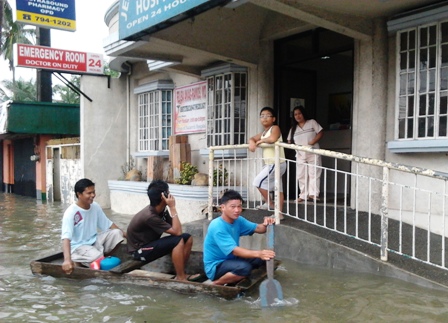
Devastating floods have recently submerged the National Capital Region and its nearby provinces in the Philippines. Photos of rising rivers and flooded streets abound the network. And on sites where comments are allowed to be posted, we see the familiar and popular blaming on garbage and squatters. Proper solid waste disposal is necessary for very important reasons, first and foremost, health. Relocation of squatter families away from danger zones is a must for obvious safety reasons. But will the floods not come if the garbage problem is solved?

In late December 2010, the northeast state of Australia, Queensland received heavy rains (200-400 mm):
Image downloaded from  http://thinkprogress.org/climate/2011/01/02/207273/hottest-year-biblical-australian-flooding/ 
The torrential rains resulted in flooding of a wide area (about 350,000 square miles - about three times the total land area of the Philippines).
Image downloaded from  http://thinkprogress.org/climate/2011/01/02/207273/hottest-year-biblical-australian-flooding/
New York had to deal with a similar situation when storm Irene drenched the northeast coast of the United States.

Flooding in Staten Island due to Hurricane Irene.
Image downloaded from  http://en.wikipedia.org/wiki/File:Flooding_in_Staten_Island.ogv
There are no squatters and garbage in the above photos, yet these places got flooded. One thing Manila shares in common with these events in other countries is the following:
Image downloaded from  http://www.facebook.com/pages/Nababaha/170625946281424
And as in other places of the globe, a similar scenario follows the large amount of rain:
Houses submerged in flood in East Bank Road in Cainta, Rizal.
Image downloaded from 
http://www.facebook.com/YouScoopGMA
What is disconcerting is that this widespread flooding in Metro Manila occurred not so long ago, in 2009, when storm Ondoy brought a comparable amount of rain to the area. Extreme weather is slowly becoming the norm. Adaptation measures are hence demanded by the new climate of the 21st century. Reihana Mohideen of Partido Lakas ng Masa said the following:
"This emerging pattern of increasingly extreme weather conditions has to be related to climate change, and those suffering the worst impact of it are the poor. The lack of adequate housing, drainage and canals, water catchments to collect water, hit the urban poor who are more than 80% of the population in Metro Manila, especially hard. This, combined with lack of information and awareness means the adaptation mechanisms of the population is extremely weak. 
We are doing what we can. but the only way that disasters on this scale can be mitigated is through the state, or government intervention. For example, today we couldn't reach some of the communities from where our organisers were appealing for assistance because of the floods. We need boats and helicopters to get out...."
What do these have to do with Philippine basic education? Schools in the Philippines face a similar dilemma. Weather, first of all, can dramatically effect basic education.
Ibaba Elementary School in Paete Laguna, Photo by Vice Mayor Rojilyn Q. Bagabaldo
Classes can not be held in flooded campuses. When roads are not passable, children cannot attend school. Widespread flooding puts a pause on all activities. And in some places, schools are used as evacuation centers. Should Philippine basic education likewise adapt to the changing climate? Most countries north of the equator begin their school year in September. The flooding caused by Ondoy in 2009 happened near the end of September. Moving the school opening in the Philippines to late September or early October means holding classes during the scorching months of March, April and May. Overcrowded classrooms coupled with poor ventilation are not only non conducive to learning, but are also unhealthy, but neither are flooded streets and classrooms. There is also the argument that weather conditions are still regional in the Philippines (for example, other parts of the country are in fact dry right now) so a solution at the national level is not really warranted.

When classes are interrupted by weather conditions, these have an effect on the rhythm and continuity of the academic program. One adaptation is to hold make-up classes. In Fairfax county of Virginia, classes sometimes stretch into summer when the number of snow days in winter prevents completion of the required number of school days. Make-up sessions also require logistics and sensitivity (or common sense). The Teachers' Dignity Coalition has recently cautioned school officials to be mindful in scheduling make-up sessions:


Study make-up classes sked, says teachers’ group


“DepEd officials must be very considerate. Teachers, students and their families were affected by the typhoon and requiring them to report to school the weekend following a week-long storm is an act of insensitivity” 
- Benjo Basas, National Chairperson, Teachers' Dignity Coalition
Similar to communities having to face serious problems beyond garbage, schools are challenged beyond the curriculum. And like the society at large, the challenges are not just coming from the climate.


80% of public schools have building defects

By 

"When it rains, it really pours. That is, as far as the public schools are concerned.

Add to the country’s severe lack of classrooms the woes of structural defects found in 80 percent of public school buildings inspected by the Department of Education (DepEd) and Department of Public Works and Highways last year.

The random inspection found that eight of 10 of some 1,300 public schools suffer from structural defects that include cracks on walls, roofs and floors due to the building’s age...."
Add to this the poor working conditions and low salaries of public school teachers, and one can easily see that Philippine basic education truly faces problems beyond the curriculum. Adaptation requires correctly setting priorities.


Postscript

Years ago, I had a casual conversation with Mutuk Bagabaldo, the vice mayor of Paete, Laguna. I was pointing out to him that the future of the town is in its uplands, that climate change will drastically change the landscape of the town. Of course, this puts the Sierra Madre into further exploitation. Thoughtful and careful planning is required. Then he visited us here in Virginia and saw how similar the terrain is in our counties is to the uplands of Paete.

In the United States, families often inquire about the quality of schools in an area before choosing their place of residence. Basic education factors in the price of houses in America. Responsible parents do consider the education of their children as well and sometimes, this is even more important than job opportunities. Decongesting the large urban centers of the Philippines perhaps require a strategy of building schools where people should be building their homes. Successful relocation of squatters from danger zones needs new sites that also provide quality schooling for their young. In a way, building schools is part of community planning. And in the long run, it maybe easier to build schools outside danger zones than attempting to mitigate circumstances.

The Philippine government and its people continue to ignore the warning from scientists. It is true that these disasters are partly man-made but the real causes are ignored. Instead, the people and the government put their hopes on flood-control schemes, constructing drainage pathways, and blaming the problem not on the main reasons.

Sea levels are rising, the land is sinking, and extreme weather is slowly becoming the norm. These are the real causes. Nature is simply reclaiming what belongs to nature. Here are excerpts from

Global sea-level rise is recognised, but flooding from anthropogenic land subsidence is ignored around northern Manila Bay, Philippines
Kelvin S. Rodolfo and Fernando P. Siringan
Disasters, 2006, 30(1): 118−139. © Overseas Development Institute, 2006
Published by Blackwell Publishing, 9600 Garsington Road, Oxford, OX4 2DQ, UK and 350 Main Street, Malden, MA 02148, USA

"Land subsidence resulting from excessive extraction of groundwater is particularly acute in East Asian countries. Some Philippine government sectors have begun to recognise that the sea-level rise of one to three millimetres per year due to global warming is a cause of worsening floods around Manila Bay, but are oblivious to, or ignore, the principal reason: excessive groundwater extraction is lowering the land surface by several centimetres to more than a decimetre per year. Such ignorance allows the government to treat flooding as a lesser problem that can be mitigated through large infrastructural projects that are both ineffective and vulnerable to corruption. Money would be better spent on preventing the subsidence by reducing groundwater pumping and moderating population growth and land use, but these approaches are politically and psychologically unacceptable. Even if groundwater use is greatly reduced and enlightened land-use practices are initiated, natural deltaic subsidence and global sea-level rise will continue to aggravate flooding, although at substantially lower rates... 
...Some people are reluctant to recognise that their own prodigal use of groundwater contributes to subsidence and the consequent flooding. Furthermore, the heavy seasonal rains leave the mistaken impression that the exceedingly abundant water must be recharging the ground below, no matter how much is withdrawn. Part of the difficulty lies in the fact that the process is hidden; it is much easier to blame flooding on visible causes such as fishponds and slums encroaching on estuaries, and the choking of drainages by water hyacinths and garbage. Some people have learned about the ramifications of their excessive groundwater use but, denied alternative sources, have resigned themselves to the worsening situation. Many acknowledge that free-flowing artesian wells must aggravate subsidence, but fear that temporarily closing a well might result in it drying up or make the water dirty. Others would like to take action, but do not know to whom they can turn. Unlike an earthquake or volcanic eruption, the worsening floods are gradual, and permit temporary, stopgap solutions. Optimism is rampant during the flood-free half of the year, when people want to forget the wet and discomfort... 
...Government officials with little technical background cannot judge the efficacy of flood-control projects. The extent to which basic science is ignored by engineers and consultants is exemplified by a DPWH dredging project, costing approximately USD 9 million, that is meant to alleviate flooding in the Pampanga municipalities of Guagua and Lubao (Nippon Koie Co., Inc., 2001; undated DPWH brochure circulated since 2003 entitled `Pinatubo Hazard Urgent Mitigation Project'). Of the 12 kilometres of channel to be deepened, the lower 10 kilometres is entirely below mean lower-low water and thus almost always below sea level. The configuration of the submarine channel floor is characterised in the plans as a `slope affected by tides'. There is no slope; besides, what governs channel flow is the slope of the water surface, not that of the bottom. Dredging below sea level can only facilitate the flow of incoming and ebbing seawater... 
...The engineering project that elicits our greatest concern is designed to protect KAMANAVA from both rainstorm and tidal flooding through the use of dikes, river walls, flood-control gates and pumps. Funded with a Japanese loan of five billion pesos, about USD 90 million, the project includes an 8.6-kilometre polder dike, composed only of earth, to enclose and protect the Malabon and Navotas areas that are already at or below mean sea level. A recurrence of the 1.93-metre spring tide, the highest on record, would leave the polder dike with only 10 centimetres of freeboard. In Manila Bay, wave set-up can raise tide levels by as much as 80%.
The dike's height of two metres was justified by an analysis that yielded storm-wave heights of only one metre. The modellers misread the bay depths charted in metres as given in fathoms (1.83 metres), and used wind speeds of only 40 kilometres per hour—those of a mere tropical depression (Citi Engineering Co., Ltd., 2001b, pp. C-17–C-18)... 
...To curtail subsidence, two measures must be implemented. First, it would be slowed by any replacement of groundwater with surface sources. The region is bordered by mountains on which small dams could be built to store water in surface and underground reservoirs. Families and small groups of farmers in developing countries use many simple rain harvesting techniques (Pearce, 2004) that merit attention, including building low ridges to impede run-off and encourage infiltration, and restoring wetlands to their natural hydrologic roles. At the family level in other places like Bermuda, the roof of every house is built to funnel all rainwater into cisterns.... 
...Second, if groundwater is to continue to be exploited, it must be regulated. A Water Code was promulgated decades ago (Water Code and the Implementing Rules and Regulations, 1979), but the requirements are ignored, beginning with the first one: drilling permits, which dictate that pump users must consider the possibility of ‘groundwater mining’—extracting more than nature recharges—and its other bad consequences besides land subsidence...."

Tulungan sa panahon ng pangangailangan: Mag-ambag, makiisa


  Hindi nakaligtas sa baha ang mga ospital tulad ng isang ospital sa Guiguinto, Bulacan. (Kuha ni Soliman Santos)
Aktres na si Monique Wilson, at kababaihan ng Gabriela, sa isang relief mission sa Brgy. Bagong Silangan, Commonwealth, Quezon City, isa sa pinakamalubhang binaha sa lungsod. (Kontribusyon)
Patuloy pa rin ang pagbuhos ng ulan, hanggang sa pagkakasulat nito (Agosto 8, 1PM). Dahil walang sapat na paghahanda, hirap ang limitadong bilang ng rescue unitsng gobyerno na abutin ang lahat ng nangangailangan ng maraming nasalanta. Ayon sa mga ulat, 90 porsiyento pa rin ng Kamaynilaan ang lubog sa baha. Ganundin ang marami sa mga sentrong bayan sa Luzon at pati ilang bahagi ng Kabisayaan.
Samantala, sa kabila ng mga ulan, patuloy ang relief efforts ng iba’t ibang grupo, mula sa mga ahensiya ng gobyerno, hanggang TV networks hanggang non-government organizations at people’s organizations.

Kasama ni Wilson at ng Gabriela sina Angel Locsin at Phil Younghusband na namahagi ng kagyat na makakain at magagamit na relief goods sa ilang residente ng Bagong Silangan. (Kontribusyon)
Binibigyang pokus ng Pinoy Weekly ang relief efforts ng ilang NGO at organisasyong masa. Masasabing tunay na “bayanihan” ang kanilang pagsasagawa ng relief efforts,dahil maralita ang mga miyembro ng mga organisasyong masa, na naglalayong tumulong sa kapwa nilang mga maralitang nasalanta. Limitado ang kakayahan dahil naghihirap din sila, pero buung-buo ang hangaring makatulong. Nananawagan ang Pinoy Weekly na suportahan natin sila.
Narito ang ilang relief efforts ng mga organisasyong masa. Maaaring madagdagan pa ito sa susunod na mga araw.
(Matrix mula kay Arnold Padilla ng Bayan at Bayanihan Alay sa Sambayanan (Balsa).


Dagdag na mga organisasyon


Citizens Disaster Response Center : 72-A Times St., West Triangle Homes, Quezon City, Tel. No. 929-98-20/22 Contact Person: Carlos Padolina, Deputy Executive Director


Alliance of Concerned Teachers
Drop-off Center: Mines cor. Dipolog St., Barangay. VASRA, Quezon City or contact ACT office at 4539116, 4262238, 09174998608 or 09198198903 for coordination purposes. Look for Zeni Lao or Kris Navales

Karapatan National Office, Erythrina Building, #Maaralin cor. Matatag Streets, Central District, Quezon City. Please contact anyone of the following –Tinay Palabay(0917-5003879), Lui Tumlos (0917-8299202), or Girlie Padilla (0908-8941870)

Kalikasan Partylist-Drop-in center: 26 Matulungin St. Bgy. Central, Quezon City (near Kalayaan Ave.) contact # 920-9099 | 0927 702 8230

Task Force Children of the Storm Children’s Rehabilitation Center/Salinlahi Alliance for Childrens Concerns #90 J. Bugallon St., Brgy. Bagumbuhay, Project 4, QC. Contact # (632) 913-9244 or (632) 439-1053 look for Sara Espineda

All UP Wokers Alliance Relief Operation Center A. Roces cor. JP Rizal near Post Office, UP Diliman Contact Person: Prof. Judy Taguiwalo

Drop off center Souther Tagalog Area: Pamantik-KMU Block 1, Lot 8, Atis St. Milwood Subd. Brgy. Pulo, Cabuyao Laguna. Hotline: 09183473149

Southern Tagalog Serve the People Corps: contact ICA @ 09082197034 | 09058460174

Drop off center Ilocos region IHRA-KARAPATAN /CRC-Ilocos office at #4 Rizal St. Brgy 3, Bantay, Ilocos Sur or call 077-722-7933 Contact Person: Roda Tajon

Northern Mindanao Drop off center Rural Missionaries of the Philippines Northern Mindanao sub region Rm 01, Kalinaw Lanao Center for Interfaith Resources 0016 Bougainvilla Puti, Villaverde Iligan City; Tel: (63) 223 5179

Tuesday, August 7, 2012

Hanggang Kailan Tayo Magiging Mangmang Tuwing Agosto?

ni Genaro R. Gojo Cruz

Sa tingin ko, di talagang nakatutulong ang pagdiriwang ng Buwan ng Wika taon-taon sa pagpapaunlad ng wikang pambansa. Ang malala pa, mas ipinakikita ng pagdiriwang na ito tuwing Agosto na di talaga natin pinahahalagahan ang ating wikang pambansa.

Bakit kailangan pang dumating ang buwan ng Agosto upang ipakita ang pagpapahalaga at pagmamahal sa sariling wika? Di ba't sa tagal na natin itong ipagdiriwang, kailangang naisanib na natin ito sa ating buong pagkatao o sa sistema ng ating pag-iisip?

Di lamang sa buwan ng Agosto dapat ipagdiwang ang wikang pambansa kundi sa buong panahon ng ating pag-iral bilang tao at bilang Pilipino. Ito ang wika ng ating pinakamimithing pangarap, ang bukal ng ating ligaya at galit, ang wika ng ating panaginip. Sa wikang ito lamang natin maipahahayag nang tapat at buong-buo ang ating saloobin, nadarama at iniisip na hinding-hindi kayang gawin sa wikang banyaga tulad ng Ingles.

Pero sabi nga, maikukumpara sa isang bata ang mga Pilipino at ang buong Pilipinas. Lagi't laging dapat paluuin at paalalahanan. Madali kasi tayong makalimot sa mga bagay na dapat nating unahin at tangkilin bilang mga Pilipino. Maikli ang memorya nating mga Pilipino. Dagdag pa, na ang mga pinakakolonyal mag-isip ay ang mga aral na Pilipino. Bugbog sila ng mga kaalamang inangkat din sa ibang bansa. Naniniwala silang nasa Ingles ang pag-unlad. Tunay na inilalayo ng sistema ng edukasyon ng ating bansa ang mga Pilipino sa sarili nitong wika at kultura. Pero sa katotohanan, ang mauunlad na bansa sa Asia ay di bihasa sa paggamit ng Ingles tulad ng Japan, China, Vietnam, at iba pa.

Pinatutunayan ng pagdiriwang ng Buwan ng Wika na talagang mangmang tayong mga Pilipino at di talaga natin natututuhan pang yakapin at mahalin ang ating sariling wika! Sana ay nailalaan na lamang sa mas mga makabuluhang proyekto ang pondong ginagamit dito. Halimbawa, kung ang ilulunsad ng Komisyon sa Wikang Filipino (KWF) ay salin ng Harry Potter, The Alchemist, o Twilight sa Filipino, aba mas nakamamangha! Biruin mo, mababasa mo sa ating sariling wika ang pinakamabibiling nobela sa mundo? Ganito ang ginawa ng Indonesia, mas salin sa Bahasa ang mga nobelang ito. Dalawang magandang benepisyo ang napapala ng mga taga-Indonesia sa pagbasa ng mga nabanggit na nobela sa kanilang wika: Una, naiintindihan nila ang kanilang binabasa, at pangalawa, nagiging bihasa sila sa kanilang sariling wika.

Nakapagbubukas ng mata at isip ang sinabing ito ni Segundo Matias sa kanyang facebook account. Ayon sa kanya: Ilang taon na rin akong nagta-travel sa iba't ibang bansa kasama na ang Europe at US. Sa Europe at sa ibang parte ng Asia, kapag pumapasok ako sa kanilang book stores napapansin kong hindi lamang English version ng original bestsellers ang naroon, kundi lagi nang may translated version ng kanilang local language. Sa France halimbawa, kapag nagtungo ka sa kanilang book store may English at sa tabi nito'y may French. Ganoon din sa Italia, Germany, at maging sa Hongkong ay mayroong translated Italian, German, and Mandarin respectively. Naisip ko, dito sa Pilipinas bakit hindi? Sa France, Germany at ang iba pang mayayamang bansa ay nagbabasa naman sila ng English pero sa kanilang book stores ay laging may translated version sa sarili nilang lengguahe.

Nakatutuwang binabalikat ng kompanya ni Segundo Matias ang tungkuling magsalin sa wikang Filipino ng mga babasahing nasa wikang banyaga. Ito sana ang pagkaabalahan ng KWF sa mga darating na panahon.

Nakaiinis na rin ang mga kung ano-anong programang iniimbento ng mga paaralan tuwing buwan ng Agosto. Pinipilit na papagsuutin ng mga Barong Tagalog o baro't saya ang mga estudyante, pinagdadala ng mga pagkaing Pilipino, pinatutula, pinagsasabayang-pagbigkas, at iba pa. Bukod sa gastos, malaking abala rin sa mga magulang.

Wala ring halaga sa akin ang kung ano-anong temang ginagawa at ipinamumudmod ng KWF sa mga paaralan. Pilit na pilit na iniuugnay sa kasalukuyang administrasyon na kung titingnan ay wala namang malinaw na mga polisiyang pangwika.

Kung ang wikang Filipino ay batay na sa lahat ng wikain sa Pilipinas, puwede na ring patulain ang mga mag-aaral na Ilokano sa wikang Ilokano, Cebuano sa wikang Cebuano, ang batang Ilonggo sa wikang Hiligaynon. Huwag isungalngal sa kanila ang wikang Filipino na wikang Tagalog pa rin naman ang marami sa mga salita.

Sa poster ngayon ng KWF, makikita pa rin ang larawan ni Manuel Luis M. Quezon. Bakit laging si Quezon lamang ang dinadakila tuwing Agosto? Bakit di rin kilalanin sina Felipe R. Jose (Mountain Province), Wenceslao Q. Vinzons (Camarines Norte), Tomas Confesor (Iloilo), Hermenegildo Villanueva (Negros Oriental), at Norberto Romualdez (Leyte) na nakipaglaban sa kongreso. Sino sa mga mag-aaral ngayon ang nakakakilala sa kanila?

Agosto ang Buwan ng Wika dahil ito rin ang buwan ng kaarawan din ni Quezon. Lumalabas tuloy na ang Agosto ay buwan din ni Quezon na isang Tagalog. Tigilan na ang ganitong kababaw na dahilan kung bakit Agosto ang Buwan ng Wika. Huwag i-credit sa iisang tao lamang ang pagkakaroon natin ng pambansang wika noon na batay sa Tagalog.

Di tuluyang magiging intelektuwalisado ang wikang Filipino kung mananatili ang ganitong mga walang kabuluhang gawain tuwing Agosto. At di mai-intelektuwalisa ang wikang Filipino kung ang mga ahensiyang pang-gobyerno tulad ng KWF ay pinagtatrabahuhan ng ilang mga empleyadong di intelektuwalisado.

Kailangan natin ay mga limbag na babasahin sa wikang Filipino lalo na yaong mahahalagang larangan. Kailangan ang malawakang pagsasalin ng mahahalagang teksto. Kailangan ang mura ngunit de-kalidad na diksiyonaryo. Madaling sabihing intelektuwalisado na ang wikang Filipino pero nasaan ang ating mga patunay?

Itigil ang pagsasabing mahalin natin ang sariling wika dahil ang di nagpapahalaga sa sariling wika ay di makabayan. Walang maitutulong ito. Di batayan ang pagsasalita ng wikang Filipino ng pagiging makabayan at pinatunayan na ito ni Jose P. Rizal. Kailangan nating kumilos, magsalin, at maglimbag ng mga babasahing nasa ating wika.

Itigil na ang pagpapakita natin ng ating kamangmangan sa sariling wika tuwing Agosto!

_________________________________________________________________

Si Genaro R. Gojo Cruz ay tubong-San Jose del Monte, Bulacan. Nagtapos ng BSE Social Science sa Pamantasang Normal ng Pilipinas. Nagwagi ng mga gantimpala sa pagsulat tulad ng Timpalak Palanca, Gawad Ka Amado, Gawad Collantes sa Pagsulat ng Tula at Sanaysay, Dionatext, Dalitext, Ninoy Poetry Writing Contest, PBBY-Writers Prize at Makata ng Taon 2004. Ang kanyang mga tula at kwentong pambata ay nalathala sa Junior Inquirer Magazine, Liwayway, Pambata Magazine, at mga textbuk sa elementarya. Kasalukuyan siyang nagtuturo sa Pamantasang Normal ng Pilipinas at nag-aaral ng MA major in Philippine Studies sa Pamantasang De La Salle - Maynila bilang iskolar. Kapag may libreng panahon, nagkukuwento at nagtuturo siya sa mga batang-lansangan sa Binondo. (http://www.panitikan.com.ph/authors/g/ggojocruz.htm)

_________________________________________________________________

English translation of above article

Till When Would We Continue to Be Ignorant Every Month of August?

In my view, the yearly celebration of the Month of Language does not really help develop the national language. Worse, the celebration every month of August only demonstrates our true disregard of our national language.

Why do we have to wait for the month of August to arrive just to display our respect and love for our own native tongue? For all the years we have been celebrating, should this not be integrated already in our hearts and mind?

We should not be celebrating our national language only during the month of August but on every single day that we live as Filipinos. This is the language of our utmost aspirations, the spring of our joy and anger, the language of our dreams. Only through our native tongue can we truly and fully express our inner thoughts, feelings and ideas, which is not possible through a foreign language like English.

However, as they say, one can compare the Filipino and the entire nation to a child. Constant scolding and reminding are necessary. We easily forget what our priorities should be as Filipinos. We, Filipinos, have very short memories. In addition, the most educated Filipinos are those with colonial mentality. These individuals have been bombarded by knowledge imported from other countries. They believe that English holds the key to progress. The educational system of the country truly removes Filipinos from their language and culture. But, in reality, the more developed countries in Asia are not well versed in English like Japan, China, Vietnam and others.

The celebration of the Month of Language proves that we, Filipinos, are ignorant and that we have not really learned to embrace and love our native tongue. We should be using the funds allotted for the celebration on much more worthwhile projects. For example, if the Commission on the Filipino Language (KWF) launches the translation of Harry Potter, The Alchemist, or Twilight into Filipino, this would be much more impressive. Imagine, one can now read in his or her native tongue the world's best selling novels. This is what they are doing in Indonesia - there are more translations of these novels in Bahasa. And there are two great benefits to the people of Indonesia. One, they actually understand what they are reading. Second, they continue to master their own language.

What Segundo Matias said in his Facebook account is an eye opener. According to him, over the years, he has traveled through many countries including those in Europe and the US. In Europe and other parts of Asia, he noticed that their bookstores carry not only the English versions of bestsellers but also their translations in the native tongue. For example, in France, if you go to one of their bookstores, you will find books placed side by side, one in English, the other in French. The same with Italy, Germany and even in HongKong, books have been translated into Italian, German and Mandarin, respectively. I was thinking, why not here in the Philippines? In France and in Germany, and in other rich countries, where people could read in English, why do bookstores still need to carry the translated versions into their respective languages?

It is comforting to see that the company of Segundo Matias has taken the initiative to translate reading materials written in foreign language into Filipino. This should be the priority of KWF in the future.

It is annoying to see the various programs being invented in the schools during the month of August. Students are forced to wear the national costume. They are asked to bring Filipino native dishes, recite poems even in chorus. Aside from the costs, this adds distress to the parents.

For me, the various themes being made and distributed by KWF to the schools are likewise not worthwhile. These try very hard to link the programs to the current administration even though the government, upon closer inspection, does not really have clear policies for language.

If indeed the Filipino language is based on all the languages in the Philippines then it should be alright for an Ilocano student to recite a poem in Ilocano, a Cebuano with Cebuano, an Ilonggo child with Hiligaynon, instead of shoving these students the Filipino language which is really mostly Tagalog.

With the current KWF poster, a picture of Manuel Luis M. Quezon can be easily seen. Why is it that only Quezon is honored during the month of August. Why do we not recognize Felipe R. Jose (Mountain Province), Wenceslao Q. Vinzons (Camarines Norte), Tomas Confesor (Iloilo), Hermenegildo Villanueva (Negros Oriental), and Norberto Romualdez (Leyte) who fought in Congress. Who among our students today will recognize these names.

August became the month of language because this is also the birth month of Quezon. Thus, August is also the month of Quezon, who is a Tagalog. We should stop this shallow reasoning of why August is the month of language. We should not give the credit of having one national language that is based on Tagalog on one person.

The Filipino language will not become fully intellectualized if we continue with the meaningless activities we do during the month of August. And the Filipino language will never become intellectualized if government agencies like the KWF continue to be manned by non intellectuals.

We need to translate into the Filipino language reading materials especially those of great importance. We need widespread translation of important text. We need affordable but high quality dictionaries. It is easy to say that the Filipino language is intellectualized, but what proof do we have?

We should stop insisting that we must love our native tongue for the sake of nationalism. This is of no help. We cannot based one's love of country on one's use of the Filipino language. Jose Rizal already demonstrated this. We need to act, translate and publish in our own language.

We need to stop displaying our ignorance of our mother tongue every August!